Welcome Back, Church Planting
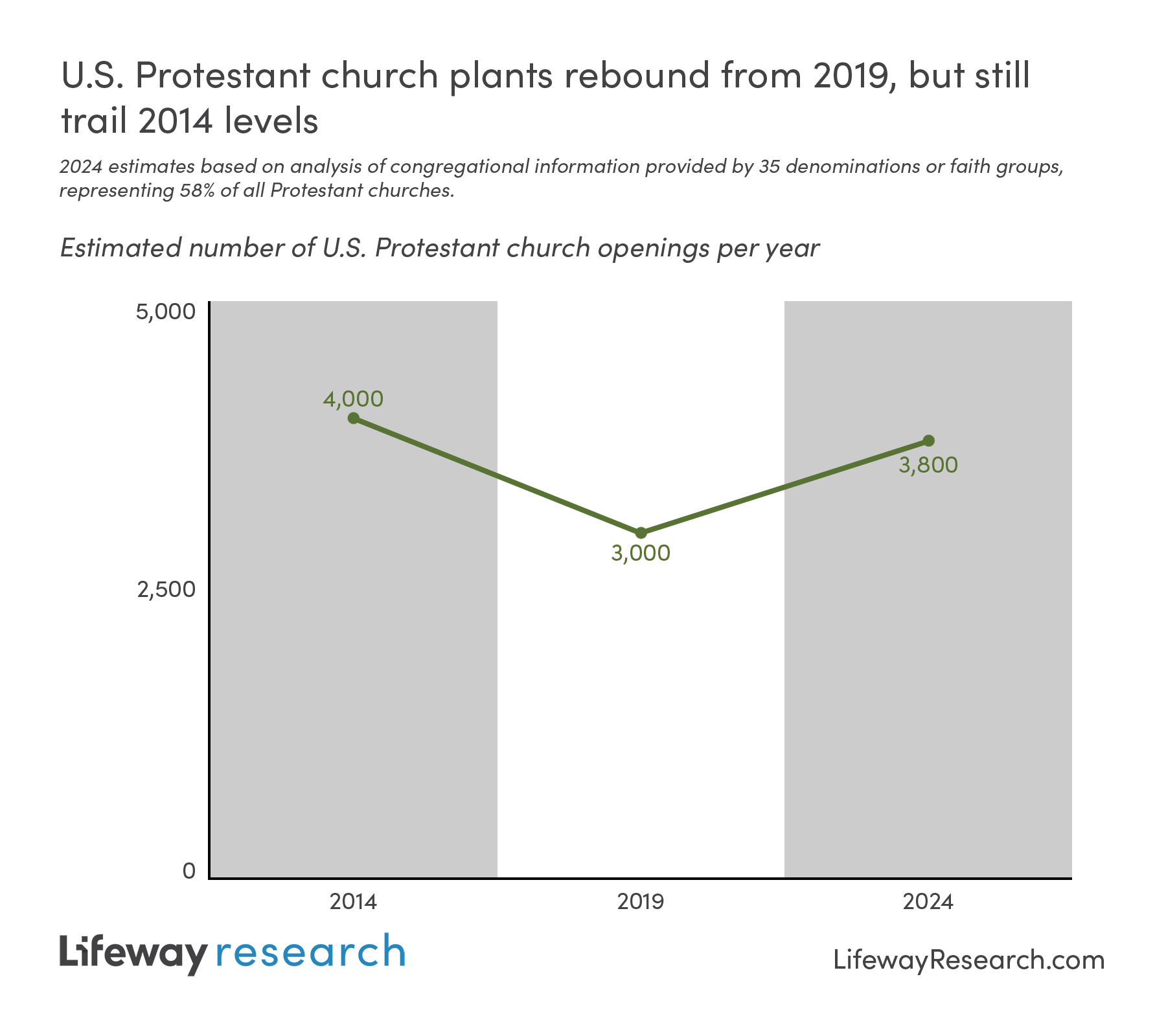
For a while, it looked like the church-planting party was over.
Back in the 2000s and 2010s, everyone was there. In 2001, Tim Keller founded City to City. In 2005, Mark Driscoll took over Acts 29. In 2008, the Pillar Network was born; in 2010, the Southern Baptist Convention (SBC) officially cannonballed in with what would become the Send Network. Harbor Network followed in 2011.
“The energy and enthusiasm about church planting in North America is at an unprecedented high,” missiologist Ed Stetzer and researcher Warren Bird wrote in 2008. Young men with beards and flannel shirts, inspired by the brashness of Driscoll and the brains of Keller, grabbed their Bibles and headed to the city centers—historically among the most difficult places to start a church.
But within a decade or two, the hype faded.
“A lot of great churches were planted, but a lot of people in that first wave also crashed and burned,” said Noah Oldham, executive director of Send Network. “Marriages fell apart, families fell apart, church planting teams had disasters.”
At the same time, the pipeline of young men dried up.
“Because it kind of happened out of nowhere, every college pastor, associate pastor, or student pastor that was hungry, ready, and gifted planted churches,” Oldham said. Once they were all sent out, “there was no backfill.”
Indeed, interest in pastoring seemed to be waning across the board. In 2017, the number of MDiv degree-seekers at evangelical seminaries began to drop.
“All this is coming together—an anxious generation, a higher degree of fragility, a lessening of resilience because of overprotection,” said Chris Vogel, church planting and vitality coordinator for the Presbyterian Church in America (PCA). “A lot of the shift was students moving from wanting to be the pastor of a church to wanting to be ordained to be a counselor.”
It looked like the planting party was over.
And then, around 2021, Send Network’s numbers began to creep back up. Pretty soon, Acts 29 was seeing the same thing.
“Two years ago, we had 125 men in the planting pipeline,” Acts 29 vice president of church planting Adam Flynt said. “Today, that’s over 450 guys. In two years, it more than tripled.”
The PCA wasn’t far behind.
“In 2025, the PCA began 54 new works,” Vogel said. “That’s the highest number in 20 years.”These aren’t anomalies—church plants for all Protestant congregations rose significantly between 2019 and 2024.
It’s another party—but this one looks less like a solo planter experimenting with Bible studies in a bar and more like well-supported teams reading books about best practices. The participants are older, moving slower, and more likely to appreciate assessment and accountability.
That hasn’t been a bad thing.
“We are seeing not only the number of plants go up, but the survivability rate has increased as well,” Oldham said.
“I’m very encouraged,” Vogel said. “I think we’re at the precipice of a really good change.”
Seeker Sensitive in the Suburbs
“The last time we saw a significant number of new churches was after World War II,” Vogel said.
That’s because the large number of returning men—and the enormous number of the children they were producing—led to a housing crisis. As houses went up in the newly created suburbs around American cities, churches soon followed.
“During this period, the operative term was not so much ‘planting’ as it was ‘extension,’” Stetzer wrote. “Specific churches would partner with their denomination to extend new churches into a given area.”
But as American culture became more individualistic, so did church planting. Focus shifted from the church to the planter, Stetzer said.
This entrepreneurial focus naturally bent toward pragmatism and professionalism. Church leaders talked about the homogenous unit principle (people like to become Christians without crossing racial, linguistic, or class barriers) and seeker sensitivity (church services “designed to appeal to the unchurched, non-Christian, in an attempt to draw them into the church community where they might receive the gospel and be converted”). Those ideas soon went too far, leading to therapeutic preaching, numbers-based definitions of success, and businesslike leadership development summits.
The problems with running a church like a Fortune 500 company were so apparent that pushback arrived in multiple forms.
One of them was the Reformed movement.
Perfect Timing
In the 2000s, young men with early internet connections began to discover the doctrines of grace, expositional preaching, and the Puritans. Soon, dynamic preachers such as Piper, Keller, and Driscoll began challenging young men to use that knowledge to plant churches.
“Guys are getting this hunger: What if we could start churches like that?” Oldham said. “And the denominations and networks were saying, ‘You can.’ And the money began to come in. The timing was perfect.”
Back then, potential planters were plentiful.
“One reason was the maturing of youth ministry,” Flynt said. “Having a youth pastor was a relatively young endeavor in the church—that didn’t really occur until after the Jesus Movement in the late ’60s or early ’70s.”
It turned out to be a great place for pastoral training.
“After 10 or 20 years, you’ve done a lot of things that a senior pastor does, just on a smaller scale and with a new generation,” Flynt said. “You teach weekly, organize groups, go on trips, raise up leaders, manage budgets. The advent and maturing of youth ministry was almost like an incubator for that early push of church plantings.”
Their childhood culture also helped. The youth and associate pastors of the 2000s and 2010s were the tail end of Gen X (the least-parented, latchkey cohort) and the front end of the millennials (the confident, eager to lead generation).
“There was an independence, a ‘don’t tell me I can’t do that’ streak in that group,” Flynt said. There was also the zeal of the newly converted—Reformed blogger Tim Challies remembers that “it was like 1 million people were all in cage-stage Calvinism at the same time.”
“There was a missional vigor that rose up,” Flynt said. “They wanted to do hard things.”
Planting Hard
One of the most difficult things you can do in ministry is to plant a church. If you want to make it even harder, try planting a church in the center of a city, where religious affiliation is low and violent crime rates are high.
Not enough of a challenge for you? Try doing it alone, without a team.
“The first 8 to 10 years were like the Wild West,” Oldham said. “There was no accountability, because there was no real oversight. Networks didn’t fully exist.”
Even as they began to develop, networks didn’t necessarily offer comfort or security.
“The night before I got assessed with my previous network, one of the guys sticks his finger in my chest and says, ‘Wear a cup,’” Oldham said. “And then he looks at my wife and says, ‘Bring tissues.’ So what he just told me was he was going to kick me in the crotch and make my wife cry—these godly men who are going to assess my calling to start a church.”
Things started rough and got rougher.
“I would come to church-planting events, and I’d almost always hear the same thing,” Oldham said. “They’d say, ‘Church planting is hard and difficult. It almost killed me. Don’t do it like me.’”
But of course, the implicit—and sometimes explicit—message was: Do it exactly like him. Stay up late. Get up early. Work so hard you make yourself sick. If you can do it with almost no money or support, that’s even better.
Surprisingly, none of this deterred the church planters of the early 2000s.
In 11 years, Acts 29 went from 23 churches to 550. City to City funded and trained another 300. The PCA was planting about 50 churches a year; the SBC was adding around 1,000 annually.
Others caught the party fever too—in 2000, several nondenominational pastors started the Association of Related Churches and were averaging around 50 plants a year by 2014. But on the whole, “it was a Reformed movement,” Oldham said. “Calvinism definitely poured fuel on the fire.”
As a result, many of the 4,000 new churches in America in 2014 had good expositional preaching, a healthy plurality of elders, and solid gospel-centered theology.
“As you exposit the text and you preach it, you see the church needs to align with it,” Oldham said. “Ecclesiology is now clear. So you’re planting churches that look like the Bible. There’s clarity. There’s structure. It was like a trellis, and the church-planting movement could grow on it.”
Some of the slats in the trellis were books.
“I have books from my seminary that predate the Young, Restless, Reformed movement, and I have books I’ve read after that, and they’re vastly different,” Oldham said. “The talk of church leadership went from being very church-centric—how to run a committee or how to build a church staff—to how to lead in a city, how to be a movement leader.”
Dropoff
And then the music stopped.
By 2019, the SBC’s church-planting class was just 552—about half of what it’d been in 2014. The number of church planters in the PCA was down in the 20s. Acts 29 had dipped to just 125 planters globally.
“A number of things were happening there,” Flynt said. “One was just the maturing of the church-planting movement. . . . People didn’t just hand a youth guy a Bible and say, ‘Go start a church’ anymore. They started to ask, ‘Are you biblically qualified? Have you been trained? Do you have a team?’”
As the boomers aged, denominations were also beginning to lean into revitalization, Lifeway Research executive director Scott McConnell said. Restarting a church uses the same men who might otherwise have planted, but doesn’t code as a plant in church statistics.
The drop was also a sign of the times, as the increasingly combative conversations about politics, race, and sexuality culminated in the chaos of 2020. Pastors trying to hold their congregations together didn’t have the bandwidth to start anything new.
“We were dealing with internal hurt, not external multiplication,” Oldham said.
Not only that, but the “woke” culture—especially in conjunction with the generally screen-based, overprotected childhoods of the younger millennials—didn’t encourage bold, risk-taking endeavors. Even leading an established church seemed less appealing.
Overall, Americans planted 3,000 churches in 2019. Not only was this 75 percent of what they’d done in 2014, but it wasn’t enough to reach replacement level. About 4,500 churches closed that year.
Reboot
In 2021, signs of a new church-planting party began to appear.
“There is something happening in our culture right now,” Oldham said. “Think about what happened in the first wave of church planting—Mark Driscoll attracted young men in their 20s and 30s who were frustrated with the culture around them and saying, ‘There’s gotta be a better way.’”
Gen Z’s male frustration has been well documented.
“What if we could harness that?” Oldham said. “Let’s grab young men. Let’s equip them with the gospel. Let’s teach them to avoid the pitfalls of generations ago, and let’s plant more churches.”
It looks like that’s already happening.
“We’re seeing the rise of faith in young men outpace women for the first time in about 100 years,” Flynt said. “We’re standing on the cusp of a tremendous opportunity right now in church planting.”
Over the last two years, the number of planters in the Acts 29 pipeline more than tripled. City to City helped with 446 plants and revitalizations in 2025, up from 90 in 2020. Last year, the number of SBC church plants popped back up to 2016 levels.
But this time around, the party feels less impromptu-bash-at-the-farm and more well-planned-dinner-party.
“Our planters today don’t want the single big personality,” Flynt said. “They want serious biblical fidelity. They want to missionally engage. They want community, not just for the sake of community, but because there’s a shared mission that we’re on.”
They also want a chaperone.
“I see a lot of young guys who are eager to be trained,” Flynt said. “They’re humbling and submitting themselves to that. And that’s an incredible thing. I’ll take humility over pride any day of the week.”
At Acts 29, “there aren’t any more Lone Ranger church planters,” Flynt said. Everyone is placed in a coaching cohort, often geographically connected to one another.
Planter assessment and training are also less crazy and more considered than before. Vogel is clear on the four core competencies—gospel, emotional, relational, and leadership—that the PCA is looking for. The denomination’s assessment—now called “ministry discovery”—is gentler.
Denominations these days are less apt to pressure “every church to plant a church” and more likely to encourage several churches to plant together, Vogel said. They’re also more selective about who they’re financing, looking for close doctrinal alignment, Oldham said. And they’re more thoughtful about their support.
“We know we have to care for these guys,” he said. “We have to create a safety net. And that’s gotten better along the way.”
All of this means preparation for planting takes longer. The average age of an Acts 29 planter has “inched up over the years,” Flynt said. The Evangelical Council for Financial Accountability found the average age of an American church planter rose from 36 in 2007 to 42 in 2022.
As you might expect, an older, better trained, more supported church planter is more likely to succeed. Nearly 90 percent of SBC plants now last longer than four years, Oldham said.
And since 2021, “no church plants that launched—and stayed—with Acts 29 have closed,” Flynt said.
Why Plant?
“Virtually all of the great evangelistic challenges of the New Testament are basically calls to plant churches, not simply to share the faith,” Tim Keller wrote in 2002. “Why would this be? . . . Only a person who is being evangelized in the context of an ongoing worshiping and shepherding community can be sure of finally coming home into vital, saving faith. This is why a leading missiologist like C. Peter Wagner can say, ‘Planting new churches is the most effective evangelistic methodology known under heaven.’”
Like so many of the Bible’s other commands, research backs it up.
“Congregations founded since 2000 are the most likely to be growing, and the regions most likely to see growth in the past five years are the Northeast and the West—precisely where Southern Baptists have concentrated church-planting energy,” Oldham wrote.
Plants are more likely to reach younger and more ethnically diverse populations, Lifeway found. They’re also more likely to reach non-Christians.
“In the most recent year with available data, nearly a third—29 percent—of all reported baptisms in states outside the South came from churches started since 2010,” Oldham wrote.
Those churches were started by guys wearing flannel shirts in their living rooms, young men who worked themselves sick and learned a hundred lessons along the way, and now by men leading church-planting teams to well-scouted locations.
“There are seasons,” Vogel said. “You depend on God differently in different seasons, and those seasons are never wasted. We know that personally, and Romans 8:28 is clear about it. Those moments in our history—good and bad, exciting and mundane—the Lord uses all of those to move his mission forward in the world.”
Popular Products
-
 Classic Oversized Teddy Bear
$23.78 -
 Gem's Ballet Natural Garnet Gemstone ...
$171.56$85.78 -
 Butt Lifting Body Shaper Shorts
$95.56$47.78 -
 Slimming Waist Trainer & Thigh Trimmer
$67.56$33.78 -
 Realistic Fake Poop Prank Toys
$99.56$49.78