3 Third Shot Drop Fixes That Make Your Drop Unattackable
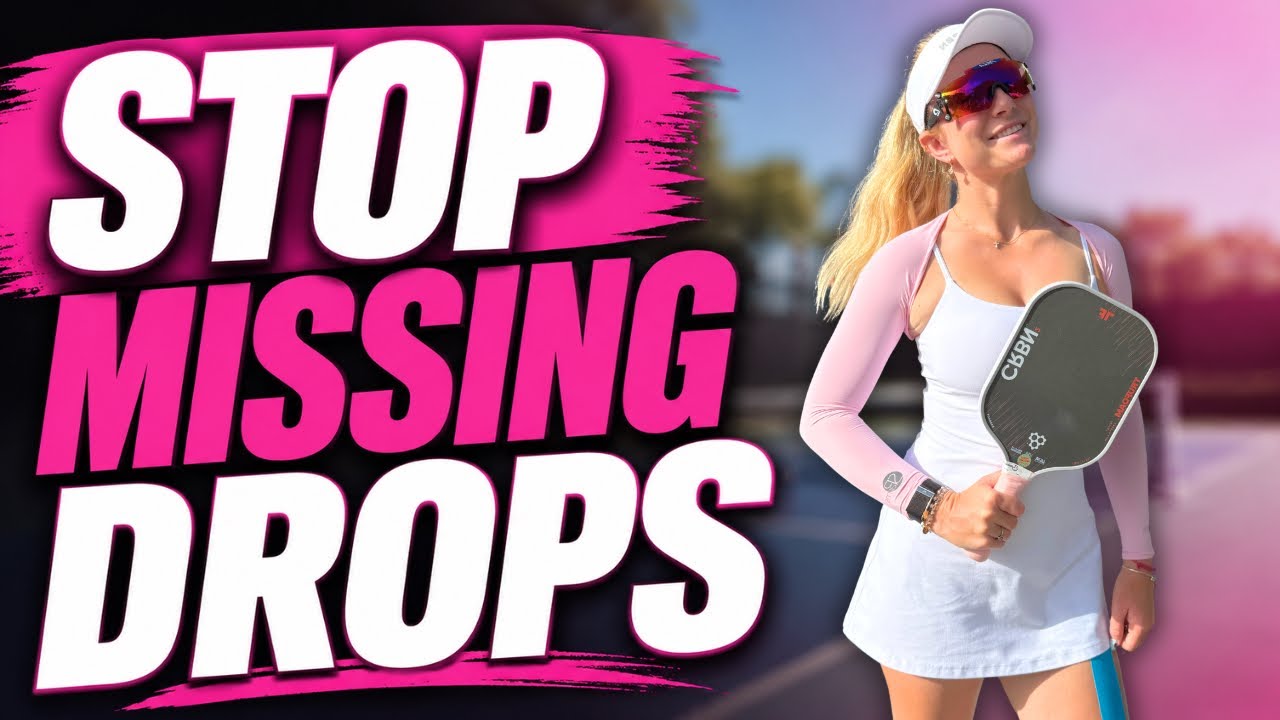
If your third shot drop keeps getting attacked, you are probably making one of three mistakes. Fix your height, depth, and forward momentum to make your drop truly unattackable.
If your third shot drop keeps getting attacked, you are not alone. Most players make the same three mistakes, and they do not even know it.
The good news is that each mistake has a specific, practical fix. Get all three right and your drop becomes one of the hardest shots in the game to deal with.
These fixes come from Ashley Griffith, a professional player on the PPA Tour who breaks down exactly why drops fail and what to do instead.
Love pickleball? Then you'll love our free newsletter. We send the latest news, tips, and highlights for free each week.
What Makes a Third Shot Drop Actually Work?
A third shot drop is not just any soft shot toward the kitchen.
It is a specific shot designed to force your opponent to reach down, hit upward, and give you time to move in and take the net.
When it works, your opponent cannot attack it. When it fails, they are smashing the ball right back at you before you even reach the transition zone.
The three variables that determine whether your drop works or fails are height, depth, and forward momentum through the shot.
Most players get at least one of these wrong every single time they step to the baseline, which is exactly why the drop shows up on every list of essential pickleball shots to master.
Fix 1: You Are Aiming at the Wrong Part of the Court
The most common misunderstanding about the third shot drop is where the ball should peak.
Most players think they need to barely clear the net, keeping the ball as low as possible.
That thinking is wrong, and it is the main reason your drops get attacked.
The ball should peak a few feet before the net, not at the net and not past it. When the ball peaks before the net, it is already dropping by the time it crosses.
That means it is descending into the kitchen and your opponent has to hit it off the bounce or reach down to get it.
When you aim to barely clear the net, two things go wrong. The ball either clips the net or it arrives at a flat, attackable angle that your opponent can punish easily.
Here is what the correct arc looks like in practice:
- The ball rises off your paddle with a low-to-high swing path.
- It reaches its highest point about two to three feet in front of the net on your side.
- It then drops naturally over the net and into the kitchen.
- Your opponent sees it falling and has to adjust their paddle angle upward to return it.
Think of it as lofting the ball rather than pushing it. The arc is the weapon, not the speed.
If you want to understand exactly how the apex of your drop affects everything, this breakdown on the apex fix goes deep on the same concept.
Why Does Height Control Matter So Much?
When your drop arrives too high, your opponent can take it out of the air and put it away.
When it arrives too low and flat, they can counter it from a comfortable position.
The sweet spot is a ball that dips into the kitchen with enough arc that your opponent is forced to bend their knees, reach forward, and hit upward.
A ball you have to hit up on is a ball you cannot attack.
That is the whole point of the shot. You are not trying to win the point on the third shot.
You are buying yourself time to get to the kitchen line, which is the whole reason the drop still anchors modern pickleball strategy.
Fix 2: Your Drop Is Landing in the Wrong Spot
Height is only half the equation. Even if your arc is perfect, a drop that lands too short or too long gives your opponent an easy ball.
Too short and the ball bounces up into a comfortable hitting zone. Too deep and it sits up where your opponent can counter without reaching at all.
The target is your opponent's feet, specifically the area that makes them stretch forward and hit up on the ball.
Ashley Griffith calls this "dipping it at the feet."
The goal is to land the ball in the last third of the kitchen, close enough to the non-volley zone line that your opponent has to reach for it rather than step into it comfortably.
Getting that depth requires topspin. Here is how to generate it:
- Start your swing from low, with the paddle face slightly open below the ball.
- Brush upward through contact, creating a low-to-high motion that adds forward rotation to the ball.
- Aim at your opponent's feet, not a spot on the ground in front of them.
- Let the spin do the work of pulling the ball down into the kitchen.
Spin and depth work together. Topspin creates the dip that makes the ball fall short enough to be unattackable but deep enough to be dangerous.
This is directly connected to why so many players keep popping the ball up when they try to reset.
If you struggle with that too, here are three fixes for popping the ball up that apply equally to drops and resets.
Is There a Difference Between a Good Drop and a Great Drop?
Yes, and the difference comes down to where exactly the ball lands relative to your opponent's body. A good drop lands in the kitchen and forces a neutral return.
A great drop lands at your opponent's feet and forces an upward shot they cannot control.
Targeting the feet is the pro habit that separates a drop that neutralizes the point from a drop that actually creates an advantage for you.
Players like Anna Leigh Waters do this consistently at the highest level, and it shows up in the 2025 medal counts.
Every drop is aimed at a specific zone, not just "somewhere in the kitchen."
That precision is what you are building toward with this fix.
Fix 3: You Are Stopping Your Body When You Hit the Drop
This is the fix most players never think about.
Your footwork and body momentum during the drop affect the shot just as much as your swing mechanics.
A lot of players hit the drop and either stop moving or fall backward. That is the opposite of what you need.
The third shot drop is supposed to start your journey to the net, not pause it.
Ashley Griffith is clear on this point. You need to be transferring your weight from your back foot to your front foot as you swing.
No tension in the body, a relaxed arm, and a smooth follow-through that naturally carries your weight forward.
Here is what the footwork should look like on every drop:
- Load onto your back foot before you swing.
- Step into the ball, shifting weight to your front foot during contact.
- Finish your swing with your body moving toward the net, not away from it.
- Stay relaxed through the entire motion, no gripping the paddle tight or tensing your arm.
When you fall back or stop, two things happen. First, your swing becomes short and choppy, which kills the arc.
Second, you lose the forward momentum you need to start moving into the court after the shot.
This is exactly why the concept of flow in pickleball matters so much.
The best drops feel effortless because the player's movement and swing are working together, not against each other.
How Does Tension Affect Your Drop?
Tension in your grip and arm is the silent killer of touch shots.
When you grip the paddle too tight, you lose the soft hands needed to control the arc and depth of your drop.
A relaxed grip gives you feel. Feel is what lets you adjust the angle and pace of the drop in real time rather than just sending the ball and hoping.
If you tend to tighten up on important points, your drops will get worse exactly when you need them most.
Practice the swing at low intensity until the relaxed, flowing motion becomes automatic, and build it into the drills you need to play your best pickleball.
Putting All Three Fixes Together
Each of these fixes is useful on its own. But the real improvement comes when all three work together on the same shot.
Start with the right arc, peaking before the net. Add topspin to pull the ball down at your opponent's feet.
Then let your forward momentum carry you toward the kitchen as soon as contact is made.
That combination creates a drop that is genuinely unattackable.
Your opponent has to hit up, you are already moving forward, and you arrive at the kitchen line ready to take control of the point.
Understanding when to drop versus when to drive is also worth thinking about.
This three-zone system for deciding between a drop and a drive is a practical framework that fits directly with what Griffith teaches here.
Common Mistakes to Stop Making Right Now
Even with these fixes in mind, a few habits will keep showing up and pulling your drop off track. Watch for these specifically:
- Swinging straight through instead of low to high. The arc disappears and the ball arrives flat.
- Aiming at a spot on the ground instead of your opponent's feet. You will land short consistently.
- Rushing the shot. A hurried swing produces tension and kills touch.
- Falling back after contact. You lose both the shot quality and your transition momentum.
These are not random errors. They are patterns, and patterns are fixable with focused practice.
If you are working on building your baseline game more broadly, the three forehand drop techniques here cover additional mechanics that pair well with what you have just read.
Why the Third Shot Drop Is Still Essential
Some players think the third shot drop is becoming less important as the game speeds up. That thinking is wrong.
The drop is the shot that gets you to the net.
Without it, you are stuck at the baseline, playing into the hands of opponents who are already set up at the kitchen line.
The drive has its place, but the drop is still the most reliable way to neutralize the net advantage your opponents hold on the third shot.
Learning to hit it consistently is one of the biggest improvements any intermediate player can make.
If you are newer to doubles strategy, understanding why the third shot matters so much will make these mechanics click even faster.
The three fixes are simple in concept. Height before the net, depth at the feet, and smooth forward momentum.
Master those three things and your drop stops being a liability and starts being a genuine weapon.
For anyone who wants to go further on the shot mechanics, this guide on the forehand third shot drop covers grip, contact, and swing path in even more detail.
And if the backhand version is giving you trouble, the backhand drop breakdown walks through the same principles from the other side.
Work on one fix at a time in drills, then bring all three together in live play.
That is how the drop stops being a problem and becomes something your opponents genuinely fear.
Frequently Asked Questions
Why does my third shot drop keep getting attacked?
Your third shot drop is getting attacked because it is arriving too flat or too high, giving your opponent a comfortable ball to put away. The fix is to create more arc by letting the ball peak before the net, so it drops into the kitchen rather than flying in level. A ball that is descending is much harder to attack than one arriving at the same height it was hit.
Where exactly should a third shot drop land?
The ideal third shot drop lands in the back portion of the kitchen, close to your opponent's feet. You want them reaching down and forward to return it, which forces them to hit upward rather than drive the ball back. Aim at the feet, not a general area of the kitchen.
How do you add topspin to a third shot drop?
Topspin on a third shot drop comes from a low-to-high swing path where you brush up through the back of the ball at contact. Start with your paddle below the ball and finish with your paddle face traveling upward through the swing. That brushing motion creates forward rotation that pulls the ball down into the kitchen with depth.
Should you move forward when hitting a third shot drop?
Yes, your weight should be transferring from back foot to front foot as you make contact with the ball. Falling back or stopping completely leads to a choppy swing and kills the arc and touch on the shot. The drop is supposed to start your move toward the kitchen, so forward momentum is built into the technique itself.
How is a third shot drop different from a dink?
A third shot drop is hit from the baseline or transition zone and is designed to arc over the net and land softly in the kitchen while you move forward. A dink is hit from at or near the kitchen line in a short, controlled exchange. Both require soft hands and a low-to-high motion, but the drop covers much more distance and requires more arc to be effective.
Popular Products
-
 Photochromic UV400 Sports Glasses
$78.99$54.78 -
 Hip Trainer with 39 Gears
$98.99$68.78 -
 Arm Resistance Bands for Baseball & S...
$64.99$44.78 -
 Portable Badminton Set with Bag & 3 B...
$64.99$44.78 -
 Soft Practice Balls - Indoor Outdoor
$37.99$25.78