Active Life Wants Personal Trainers To Cure Chronic Pain, Not Work Around It
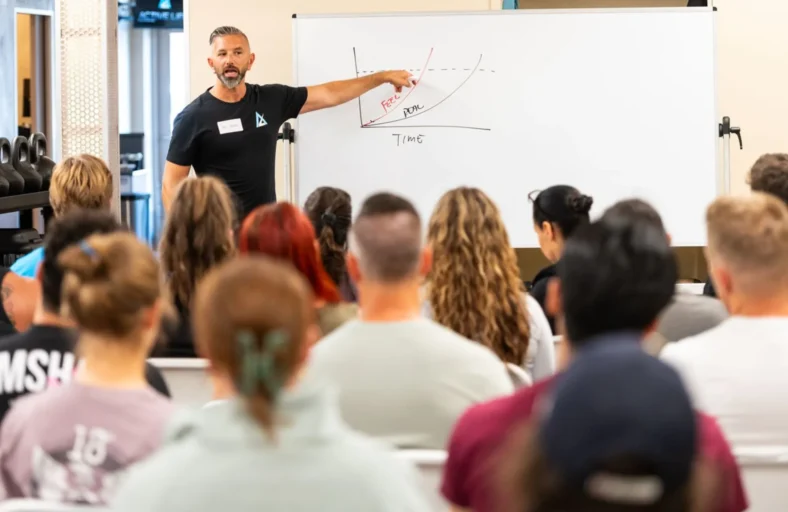
An Active Life certification costs thousands of dollars and requires an exhaustive education. Founder Sean Pastuch argues it’s worth it for trainers who want to fill the void being left by the American healthcare system
Sean Pastuch believes that living with chronic pain is largely a choice.
Through his company, Active Life, Pastuch is aiming to equip fitness professionals with the ability to eliminate clients’ chronic pain in ways he’s not observing among physical therapists and other coaches.
“We’re aiming to create a world where people understand that living with chronic pain is a choice,” Pastuch told Athletech News. “The way that we do that is by educating the people who are suffering with chronic pain on the reasons why, what they can do about it, putting them in situations that they’re otherwise afraid to be in and teaching them that they’re safe in those situations, physically, socially, mentally and emotionally.”
Active Life is a comprehensive personal development program that educates personal trainers to not only help clients overcome chronic pain, but also supports coaches in their own entrepreneurial endeavors as they build up their clientele.
Why the Industry Needs a Mindset Shift
Boldly declaring that living with chronic pain is that person’s decision could alienate potential clients who fundamentally disagree. Pastuch isn’t worried about that, though.
“Our job is not to change people’s minds,” he explained. “It’s to help people who already believe that they’re capable of a bigger life than the fitness industry (and) the medical system is telling them that they can live, who are being told that they’re the crazy ones. We want to validate their belief that life can be better.”
Pastuch started Active Life because he observed that the medical system is not suited to help people overcome chronic pain at the root cause, but rather “masks it with medications.”
At the same time, he sees the fitness industry, as it’s constituted now, as only being able to help people work around aches and pains rather than resolve them.
“What we understand is how to help coaches gain the skills and the mindset to help their clients overcome their chronic pain and restore the active life that they thought they had lost forever,” Pastuch said.
Inside an Active Life Education
Active Life’s educational philosophy embraces teaching fitness professionals — either personal trainers inside of a gym or those who own their own business — to adopt the mindset of someone who is already successful, Pastuch said.
“The reason that we struggle to find success is because we’re not the person who knows how to be successful yet. We don’t think like successful people. We don’t live like successful people. We don’t treat ourselves like successful people,” he explained. “The skills that we teach them to use with their clients actually work because they’re the kind of coach that their clients can believe in.”
When personal trainers and coaches go through the Active Life program, Pastuch said they will build their confidence and self-esteem alongside their skills to achieve results that other professionals may not.
“We’re the only company that understands helping people overcome chronic pain to live an active life is both a very high-value solution and one that requires mental, emotional, physical and social integration,” he said.
The Active Life program, which costs thousands of dollars, is exhaustive, with coaches taking about 16 months on average to complete the 30 hours of video content and over 50 assignments, with three to five hours per week of active learning through curriculum, assignments, tests and videos.
Pastuch said coaches have access to 1,000 pages of textbook, an active Slack channel and eight hours of live one-on-one calls every week with instructors.
Active Life enrollees can choose from four specialties: degenerative diseases, return to sport, pelvic health and aging populations. Once they complete a certain level of the course, they can be listed on the Active Life website for prospective clients to find.
To stay listed, Pastuch said, trainers have to complete ongoing re-credentialing requirements.
Having that Active Life credential is not a replacement for an International Sports Science Association (ISSA) or National Academy of Sports Medicine (NASM) personal trainer certification, though — this is a supplementary education for already certified coaches.
Being a part of that network can be a major boost to trainers’ and coaches’ success, as Pastuch points out that Active Life attracts a more motivated and engaged demographic willing to push their limits to end chronic pain.
“A big part of the reason why our students are able to get results that physical therapists are not is because the client they work with is more motivated to get the results than the physical therapy client is,” he said.
Seeing Results
Active Life has already had an impact on not just personal trainers and their clients seeking pain relief, but gym operators as well.
Pastuch told ATN the program helped a Gold’s Gym in New York double its personal training revenue in two months and quadruple it in 18 months, along with winning an award for best personal training department in the entire franchise after two years together — all while reducing the number of people on their training staff.
He revealed the key steps in that process that achieved those results, which included: firing all trainers who did not want to stay in that profession long-term; restructuring pricing, pay and incentive packages; eliminating all discounts and 30-minute session options; and instituting a process where every new member filled out a questionnaire disclosing what they’d value most from their membership, with “getting out of pain” yielding the most interest.
Looking ahead, Pastuch is aiming to enroll 100 new students per month and open his third brick-and-mortar location by the end of 2026.
“The gap between fitness and healthcare is larger than either fitness or healthcare, and while most people are trying to fill it with tech, I see it as a people problem,” he said. “We are going all-in on people to bridge it.”
The post Active Life Wants Personal Trainers To Cure Chronic Pain, Not Work Around It appeared first on Athletech News.
Popular Products
-
 Photochromic UV400 Sports Glasses
$78.99$54.78 -
 Hip Trainer with 39 Gears
$98.99$68.78 -
 Arm Resistance Bands for Baseball & S...
$64.99$44.78 -
 Portable Badminton Set with Bag & 3 B...
$64.99$44.78 -
 Soft Practice Balls - Indoor Outdoor
$37.99$25.78