I Tried Dexcom’s Stelo, A Glucose Biosensor, For 30 Days. Here’s What I Learned
Dexcom’s first over-the-counter glucose biosensor brings real-time glucose tracking to the wellness mainstream. After 30 days of wear, the insights reshaped how I eat, train and recover
Wearables have made it easier than ever to track how we move, sleep and recover, but glucose has largely remained a missing piece of the puzzle unless you had a medical need to monitor it. Dexcom’s Stelo is designed as the company’s first over-the-counter continuous glucose monitor for people without diabetes, so the sensor brings clinical-grade metabolic data into a consumer wellness format.
I wore Stelo for 30 days to see whether real-time glucose tracking could actually translate into better everyday decisions, or if it would end up feeling like just another data stream to manage. I wore it during normal workdays, special events, a trip overseas, and during many, many workouts to see how my glucose reacted to the way I fueled, trained, and recovered.
By the end of the month, Stelo reshaped how I thought about fueling, recovery and my daily routine.
What is Stelo by Dexcom?
Dexcom’s Stelo Continuous Glucose Monitor is the brand’s first over-the-counter continuous glucose monitor designed for adults without diabetes who want insight into their metabolic health.
The wearable sensor is applied to the back of the upper arm and continuously tracks glucose levels in real time, sending readings directly to the Stelo mobile app. Users can view glucose trends throughout the day and see how meals, exercise, sleep and stress impact their levels.
Each sensor can be worn for up to 15 days before replacement, with no finger pricks or manual scans required. Stelo is sold directly to consumers without a prescription, typically in monthly subscription packs. Pricing varies slightly by retailer and promotion, but generally lands around $99 per month for two sensors (a 30-day supply).
Getting Started with Stelo
I have tried other glucose biosensor (like Abbott’s Lingo), so the application process felt seamless. Simply hold the applicator up to your arm, press a button, and it’s on. I barely felt a prick during the application, and my arm did not hurt at all afterwards. Sometimes I could feel it against a tight shirt or during a workout while leaning on my side, but for the most part, it felt undetectable throughout the 30-day trial.
Where Stelo really begins to differentiate itself is in the app experience. Glucose readings stream continuously to your phone, displayed through clean graphs and trend lines that make it easy to see how your levels move throughout the day. You can toggle between real-time readings and longer trend views, helping connect specific behaviors, like meals or workouts, to glucose responses.
Dexcom even offers new AI-enabled app enhancements designed to make the data more actionable. An upgraded Smart Food Logging feature introduces a nutrition database of more than one million foods, providing detailed macronutrient breakdowns including calories, carbohydrates, protein, fat and fiber. Meals can be logged through text search, barcode scanning or by simply taking a photo.
The platform’s Daily Insights dashboard has also been redesigned with more tailored recommendations based on prior data across glucose, activity, nutrition and sleep, along with behavioral prompts that encourage reflection and habit change over time.
What I Loved about Stelo
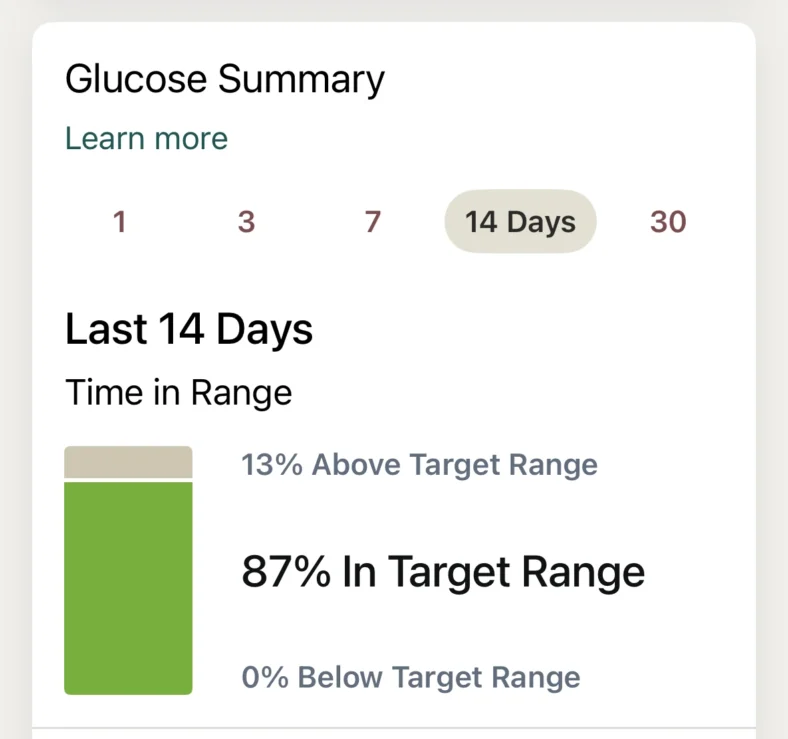
My first time testing a glucose biosensor, I was unsure of its value-add for me. I work out frequently and eat healthily, so I was unsure what glucose tracking could offer me. While my glucose levels were fairly steady throughout the trial, the fluctuations proved incredibly insightful for me.
For example, I took a seventeen-hour flight to Asia in January and realized the immense impact that walking has on glucose. It was a somewhat normal-sized meal, but sitting still for hours afterwards spiked my glucose outside of my recommended window.
In contrast, I had much larger (and more indulgent) meals during my vacation, but because almost all of them were followed by long walks, my glucose almost never spiked outside of the range.
As Dr. Thomas Grace explained during our data review, “When you can see the benefits of going for a walk after you eat, or you can see the benefits of choosing this food instead of that one that you know causes significant spikes in your glucose, it helps reinforce the behaviors that improve our metabolic health.”
You can also see the impact that workouts have on your glucose. For longer workouts where fuel is necessary, this can be extremely helpful to see if your gel or your goo is providing you with the energy you need. For example, fifteen minutes into a particularly tough Aarmy workout, my glucose dropped almost 25 mg/dL. The app integrates with Apple Health (which is already connected with my Oura Ring, and other wearables) for convenient tracking.
Stelo’s Nutritional Insights
One of the biggest selling points for a glucose biosensor is energy management. You might be familiar with the 2 pm energy crash, and you might be managing it with caffeine. But a glucose biosensor empowers you to figure out what food works best for you to manage your glucose levels.
For example, one morning I had protein pancakes, which I thought would keep my energy levels steady due to their high protein content. Instead, my glucose soared past my upper range, which I knew would come with a crash later (and it did).
“Those insights, they’re coming to you, and it’s not sometimes overnight,” Dr. Grace commented. “We have these behaviors that are ingrained in us that we’ve grown up with over decades.”
He commented that learning that food spikes your glucose does not mean that the food is bad, just that it is an educational moment about fueling patterns. “This is just a reinforcement tool that gives you those insights,” He continued.
I also loved Dexcom’s integration with my Oura Ring. By pairing data from Stelo with sleep and readiness data from my Oura Ring, I was able to identify whether late meals or glucose variability correlated with lower deep sleep or higher overnight stress markers. One night, I was working late and had dinner at 9 pm (several hours later than usual). In the morning, my Oura Ring and Stelo knew exactly what had happened, and showed me how much it impacted my rest. I also loved how the glucose monitor was integrated sleekly into the Oura app, so I had a snapshot of my health thoroughly, all in one place.
Dexcom by Stelo: The Final Verdict
Overall, Stelo felt less like a standalone device and more like a complement to the broader health and fitness ecosystem I already rely on. As someone who trains regularly and prioritizes balanced nutrition, I didn’t necessarily expect dramatic findings. But the visibility into how specific meals, travel, movement and fueling timing impacted my glucose added a new layer of context that other wearables hadn’t fully captured.
Glucose is highly personal, so everyone’s insights will be helpful in different ways. In my case, the data reinforced the power of small, actionable habits, like pairing carbohydrates more thoughtfully, prioritizing post-meal walks and refining pre-run fueling for steadier energy.
The post I Tried Dexcom’s Stelo, a Glucose Biosensor, for 30 Days. Here’s What I Learned appeared first on Athletech News.
Popular Products
-
 Soft Cover Soccer Ball
$30.99$20.78 -
 Golf Swing Trainer Practice Stick wit...
$21.56$10.78 -
 Microfiber Bowling Shammy Pad with Gr...
$7.99$9.78 -
 Adjustable Metal Kettlebell Handle fo...
$226.99$135.78 -
 Portable Foldable Table Tennis Set wi...
$506.99$353.78