Innovation Lab: “commercial Grade” Is A Claim, Not A Spec
Reformers have no enforced duty-cycle standard, so buyers compare adjectives instead of machines. The fix is a spec sheet they can check.
Ask three suppliers for a quote on 12 commercial reformers and the paperwork looks identical. All three say commercial grade. One is built for a class an hour, one is a home unit with a heavier frame, one is engineered for 30 hours a week. The difference is invisible in a photograph, and by the time it is visible the machines are already in service.
Treadmills and rowers at least tend to publish duty ratings a buyer can compare. Reformers have nothing anyone enforces. “Commercial” has become a price tier: it tells you what the seller intends to charge, not what the machine was built to survive.
The arithmetic is the whole argument. A home reformer sees maybe three hours of use a week. A studio running twelve classes a day puts 30-plus on it, with eight to 12 bodies cycling on and off, springs swapped mid-class, a carriage that never fully cools. Fatigue collects in frame joints, carriage bearings, spring hooks, and the seams where upholstery meets the platform. A machine designed around three hours does not fail on day one. It fails mid-schedule, usually on the busiest rail.
A commercial reformer is not a stronger home reformer. It is a different machine built around a different number.
Three questions buyers can ask
What duty cycle was the frame designed for? Not “is it commercial” — how many class-hours a day, how many days a week. A supplier who designed for a duty cycle answers in a sentence. One who did not answers with an adjective.
Which parts are standard and which are proprietary? Bearings, springs, clips, ropes, straps. In year three, when a spring loses tension, is it a stocked part shipped in days or a component made only for this model? That answer decides how long a machine sits dead in the corner.
What does the warranty cover, and who pays the freight? A $40 part can leave a $2,000 machine idle for three weeks. That is the number worth comparing, not the warranty length.
Ask those three and the quotes stop looking alike.
A market that no longer requires a factory
To sell a reformer under your own name, you used to have to own the means to make it. Not anymore. Production is now purchasable by the unit, so a studio, a hotel group or a first-time founder can bring a machine to market without building a plant — and a manufacturer can run a house brand on the same floor without becoming a retailer. Some companies now deliberately hold both.
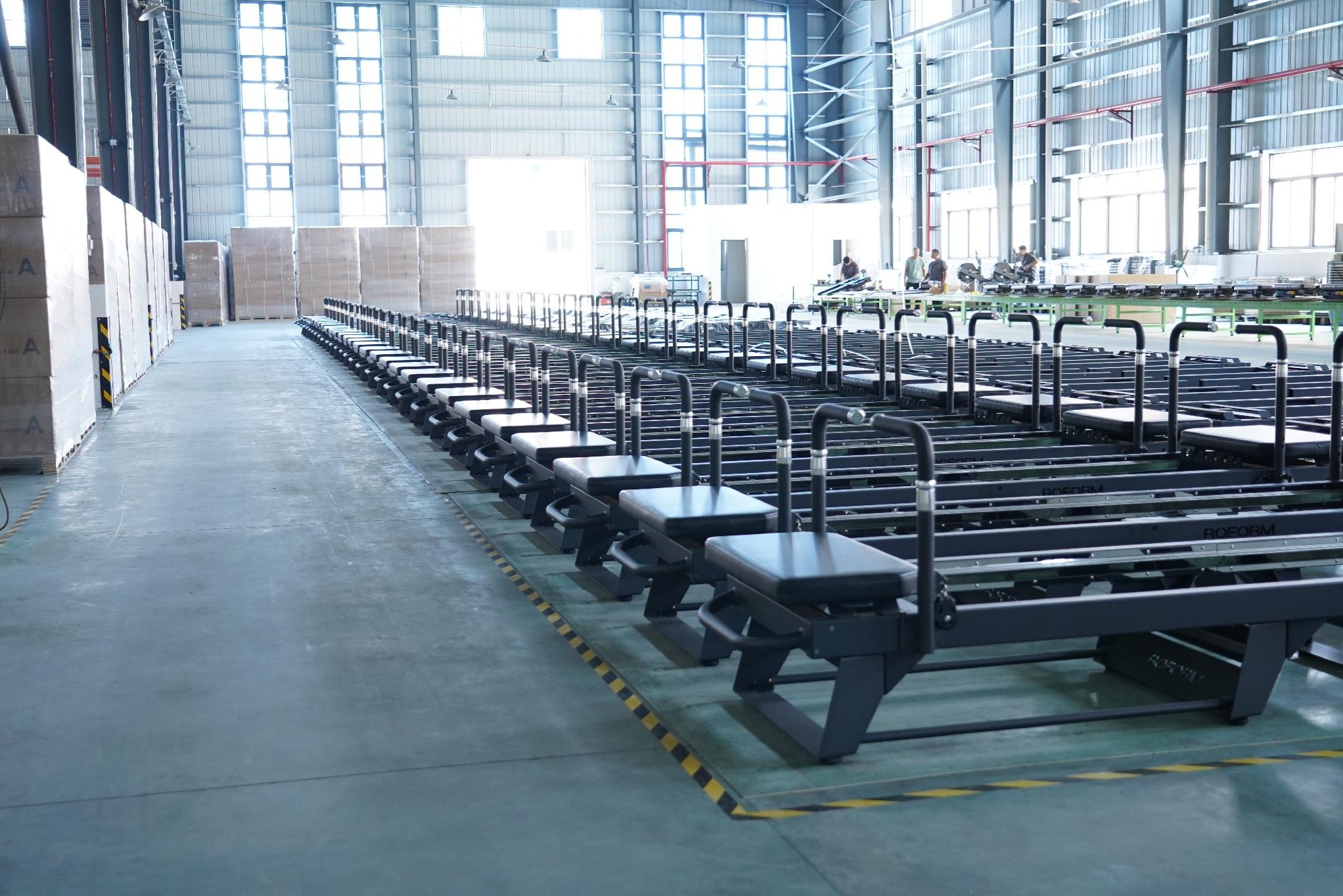
Megacore Pilates is one of them: more than twenty years on the manufacturing side of fitness equipment, and a plant in Jiangmen, Guangdong — about ninety minutes from the Guangzhou port cluster — that keeps cutting, welding, polishing, powder coating, upholstery, assembly, testing and packing under one roof.
Its range runs on two frame platforms: the C26 in stainless steel for humid climates and rooms cleaned between sessions, the K20 in aluminum alloy for rooms that convert between formats. A house brand plus OEM/ODM programs, and trial orders from one unit, with minimums for deeper customization set by model.
One roof matters for a specific reason. A change to a wall thickness or a powder batch gets checked against the same jigs and inspection routine that produced the last order. Split the chain across separate shops and nobody owns the cumulative error.
The limits deserve naming. Factory-direct trades the dealer networks and in-market service of established Western brands for cost, configurability and direct access to the people who build the machine. Buyers who need a technician on site this week are a different customer. And the three questions apply to Megacore as much as to anyone: a company arguing for verifiable specs has to let its own frame, spring and part numbers be checked.
What is being innovated is not a feature
It is that the specification conversation is becoming possible at all — that a buyer can ask for a duty cycle, a parts path and a warranty boundary, and compare the answers with the next quote.
Brands that win the next phase will be the ones whose machines can be inspected, not the ones with the better story about themselves.
More from ATN
- Just Released: Athletech’s Franchise Outlook Report
- From Hyrox to Bathhouses: Key Takeaways as Wellness Economy Hits $7.5T
- New Startups Push to Innovate Strength Training Tech
- ATHX Games Unveils USA vs Europe Competition
- Want the industry edge? Join ATN Pro for unlimited access, exclusive analysis and event perks.
Popular Products
-
 Photochromic UV400 Sports Glasses
$78.99$54.78 -
 Hip Trainer with 39 Gears
$98.99$68.78 -
 Arm Resistance Bands for Baseball & S...
$64.99$44.78 -
 Portable Badminton Set with Bag & 3 B...
$64.99$44.78 -
 Soft Practice Balls - Indoor Outdoor
$37.99$25.78