Pvolve, Jennifer Aniston Coin New Workout Category
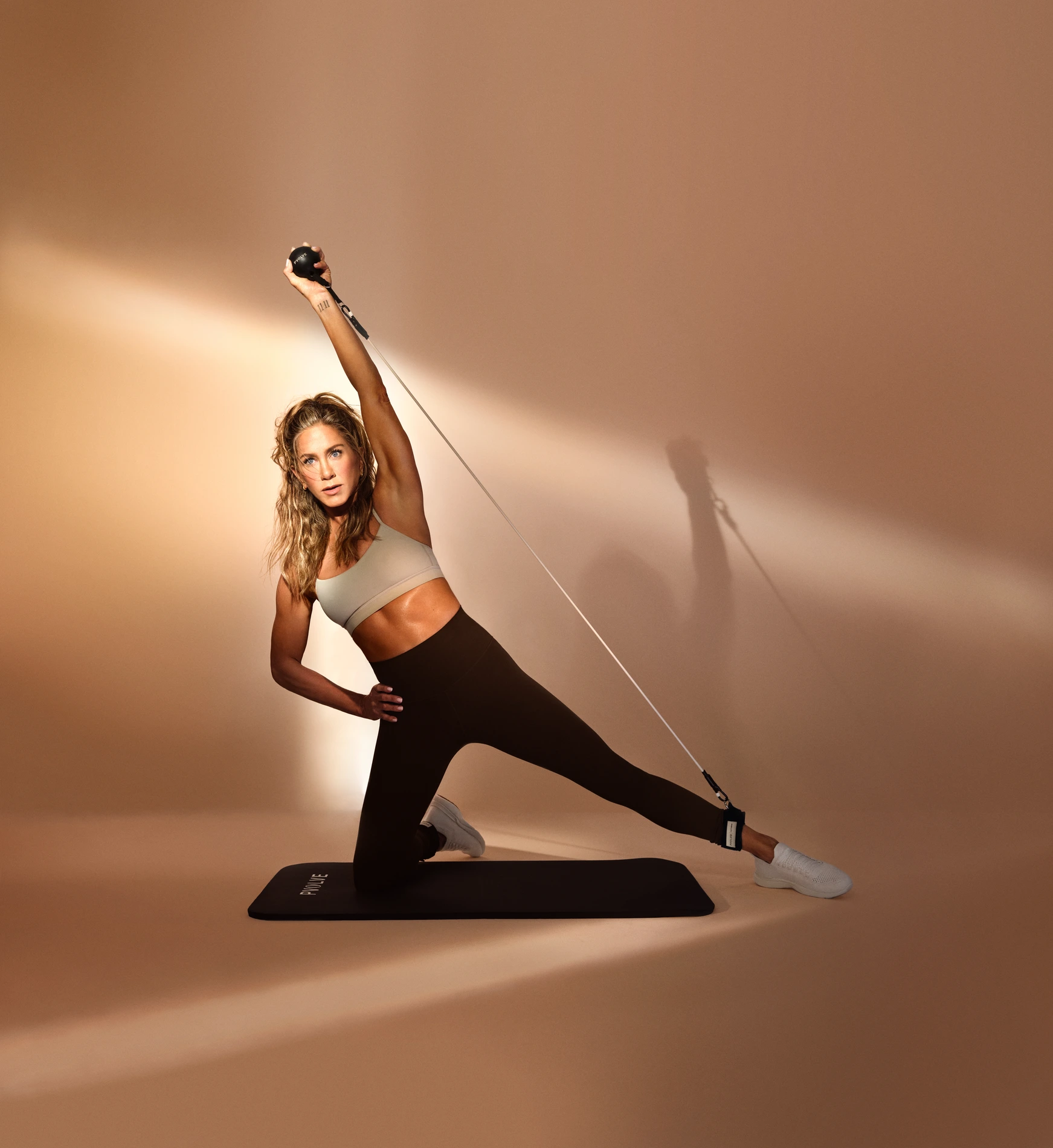
“Movement Longevity” highlights the importance of women building strength into midlife and beyond. The launch comes alongside a report that found a serious gap between women’s knowledge of strength training and how many are actually doing it
Pvolve and brand partner Jennifer Aniston are targeting a long-forgotten component of longevity for women: strength into midlife and beyond.
The science-backed workout brand is launching a new fitness category in partnership with Aniston, called “Movement Longevity.”
The 30-day structured and progressive program is modeled after Aniston’s shift towards strength training, created alongside Pvolve vice president of training Dani Coleman.
Aniston’s longevity-focused program is built around the three core pillars of strength, mobility and stability. It comes as Pvolve releases its first-ever Movement Longevity Report, which highlights a significant gap between women’s understanding of weight training’s importance, and their ability to incorporate strength workouts into their own routines.
“A lot of women are intimidated by weights or don’t know where to start. Pvolve showed me that weight training doesn’t mean lifting as heavy as possible or pushing yourself to exhaustion,” said Aniston. “Every movement works your whole body, so you get more out of every minute. It’s challenging, efficient and genuinely fun, and I’ve seen a real change in my body composition because of it.”
The report had several key findings, which paints a broader picture of how much women — especially older women — are missing out on the physiological and longevity benefits of strength training.
The online survey of 1,000+ women based in the U.S. found that while 78% say weight training matters for long-term health, 60% aren’t typically incorporating it into their weekly routines, with less than a third (28%) picking up weights 1-2 times per week and just 12% strength training three or more times a week.
A major contributing factor in that gap is lack of education and systemic support around weight training — two-thirds (66%) of women have never been told by a doctor or fitness professional to weight train, and just 16% have received specific guidance on how to begin.
“Age-related loss of muscle mass and strength, is one of the most under-appreciated predictors of frailty, falls and loss of independence in women, yet it remains almost invisible in routine care,” said Pvolve chief clinical advisor Dr. Nima Alamdari.
Over half (55%) of women ages 40-44 have never been told to weight train, while as much as 75% of women 65 and older have also not been encouraged to strength train — arguably the age groups who stand to benefit most from maintaining muscle as they age. Just 15% of respondents said they’re aware of how muscle loss affects metabolism, bone health, balance and long-term independence, with only 8% of women ages 65+ saying they understood.
That education gap, coupled with the intimidation factor that is often associated with strength training, is holding a lot of women back, the report found. Of the respondents, 27% don’t know where to start, 20% are worried about injury and 9% are intimidated by gyms and picking up weights.
While bone density is often monitored with age as concerns for osteoporosis and osteopenia rise, there isn’t the same consideration for muscle loss and strength measurements, Alamdari pointed out. According to the report, women 65 and older are more than three times as likely to have received a bone-density scan as a muscle-mass or strength assessment.
“Bone density has DEXA scans and screening guidelines. Muscle has no equivalent, even though loss of strength, functionality and body composition through menopause is as consequential as bone loss,” he said. “These should be measured and treated as vital signs.”
But in the era of GLP-1s, muscle mass and strength training are becoming an even more crucial topic of conversation than ever before. Even so, the support gap remains for older women, despite how many are taking drugs like Ozempic and Wegovy now. Over 25% of respondents currently use or previously used a GLP-1, yet only 32% said a provider told them before starting treatment that the medication could lead to muscle loss as well.
Pvolve’s shift towards weight training arrives amid a new wave of brands encouraging women to build strength. Earlier this year, women’s-only strength gym Tension opened its first studio in New York, while Founders Row backed the new women’s strength training concept LiftHer, debuting in Dallas this fall.
More from ATN
- Fitness Dating Apps are Taking Off!
- Hyrox Sold to L Catterton-Led Group in Deal That Includes Brand’s Co-Founders
- Just Released: The Business of Wellness, Recovery & Longevity explores the trends and business models driving this rapidly expanding market.
- Phillip Mills joins ATN Disrupt to Talk the Power of Community.
- Want the industry edge? Join ATN Pro for unlimited access, exclusive analysis and event perks.
Popular Products
-
 Photochromic UV400 Sports Glasses
$78.99$54.78 -
 Hip Trainer with 39 Gears
$98.99$68.78 -
 Arm Resistance Bands for Baseball & S...
$64.99$44.78 -
 Portable Badminton Set with Bag & 3 B...
$64.99$44.78 -
 Soft Practice Balls - Indoor Outdoor
$37.99$25.78