Bmax Maxmini B12 Power Mini Pc Review
BMAX MaxMini B12 Power: 30-second review
The BMAX B12 is an interesting release in the current market: rather than opting for one of the latest AI-enhanced CPU, GPU, and NPU combinations, BMAX has chosen what was three years ago, a flagship laptop CPU. Whilst it does feature an NPU, this is from the early stages of the technology, so its performance on that front is limited. However, for raw processing power alongside its integrated GPU, this mini PC is surprisingly powerful for its price tag for most productivity, creative, and even gaming applications.
We can easily forget just how powerful those older CPUs were, especially as so many of the latest releases focus on AI potential, both integrated into applications and for running LLMs. However, most of us still need to use Microsoft Office or equivalent, creative apps, browse the internet, and do some light gaming. For that kind of use, do we really need the latest CPU if we just want a decent machine?
Opening the box and lifting the small mini PC out, it’s nicely designed with a slightly dark blue finish, although the plastic casing feels a bit cheap. A quick check over the port layout shows that it’s well thought through, with two USB Type-A ports joined by USB-C, this USB-C port on the front is something that many of the leading mini PCs still fail to offer today. Of course, there’s a 3.5mm audio jack on the front as well. The back is a little sparser, with just two USB Type-A ports, an HDMI port, a LAN port, and a DP port alongside the power socket.
So essentially, a lot of savings have been made on the build and port selection, and there’s also the fact that the RAM, which is only 24GB, is soldered on, so there are no real options for expansion, although the SSD can be upgraded and there’s room for a 2.5-inch SATA drive.
During testing, the performance impressed, able to perform well for general administration and mid-weight creative tasks and applications, including 4K video editing.
Initially, I doubted whether the gaming performance would match what I’ve seen from the latest mini PCs. Still, surprisingly, even Cyberpunk 2077 was playable, although the resolution and effects were obviously dialled right down.
Whilst this machine is good and powerful, you can’t help but feel its time is limited, especially as more applications make greater use of AI. The good point here, however, is that it does have an NPU, albeit nowhere near as powerful as the latest equivalent, but the pricing does make this affordable considering the power and options that you get.
It may not be the best mini PC if your focus is on workstation-grade performance. But if you want a really good, solid office mini PC that's truly mini for day-to-day administration and light video and multimedia editing, then this is a superb option at a relatively reasonable price and proves you don’t need the latest CPUs to get a decent and capable machine.
BMAX MaxMini B12 Power: Price and availability
- How much does it cost? From £569.99
- When is it out? Available now
- Where can you get it? Directly from BMAX
Direct from the manufacturer, the BMAX B12 Power mini PC with Intel Core Ultra 9 185H can be purchased for $999.99 / £754.99, including shipping and tax, directly from the BMAX website. There are no other variations of the machine besides the one I’ve reviewed here.
A few years ago, a mini PC with this CPU would’ve cost a lot more. However, it's now heavily discounted, which, given that the CPU inside is almost three years old, makes it exceptionally good value for money.
That older technology, slightly lighter build and restrictive port selection mean that whilst it isn’t in line with the latest mini PCs, at this price it’s still a powerful machine and therefore well priced.
- Value: 4.5 / 5
BMAX MaxMini B12 Power: Specs
CPU: Intel Core Ultra 9 185H, Meteor Lake-H, 16 cores, 22 threads, up to 5.1GHz.
Graphics: Intel Arc Xe-LPG, eight Xe cores, up to 2.35GHz.
RAM: 24GB LPDDR5, soldered.
Storage: 1TB NVMe SSD, with support for additional SATA storage.
Front and Rear Ports: USB-A, USB-C, HDMI, DisplayPort, Ethernet, audio and power connections. Verify exact layout.
Connectivity: Wi-Fi 6, Bluetooth 5.2, 2.5GbE Ethernet.
Audio: 3.5mm headset connection.
Camera: No integrated camera.
Size: 126 × 112 × 52mm.
OS Installed: Windows 11 Pro.
Accessories: Confirm power adapter, cables, VESA mounting hardware and documentation.
BMAX MaxMini B12 Power: Design
The BMAX B12 Power is one of the smaller mini PCs that I’ve looked at recently, and while it does feature an entirely plastic case, it is nicely designed. Finished with a distinctive blue chassis with a BMAX logo and motif printed across the top, it’s a stylish little machine. As you lift it from the packaging, the full plastic build is notable and relatively lightweight compared with many other mid- to higher-end mini PCs.
The dimensions are 126 × 112 × 52mm, and on top of that, you do have a small power brick. It weighs just 410g, making it one of the lightest mini PCs I’ve looked at in a long while. This makes it ultra-portable, and mounting it on the back of your monitor or positioning it away from the desk is exceptionally easy thanks to its size and weight.
The processing power, size, weight, and power draw also make it a great option if you’re looking for a portable mini PC for a van. OK, it might not be the latest AI CPU, but it’s still a very capable machine for what it is. Because the port selection isn’t great, it’s well-suited to a machine that is fixed in position and doesn’t often need additional connections.
For a machine this small, the port selection, while a little sparse, gives you all the basics, though heavier users may find it slightly limiting. However, there’s still a recessed Clear CMOS button on the front if you’re using it as a homelab which sits alongside the 3.5mm headphone jack, a USB Type-C port, two USB 3.2 ports and the power button.
On the sides, there’s plenty of venting and a Kensington lock. If you do need to secure it to a desk or within a van. The back has more venting and a 2.5GbE LAN port, which is great to see, as some older and entry- to mid-range machines use only a 1GbE LAN port. Then we have two USB 2.0 ports, which are really only suitable for the keyboard and mouse, plus HDMI, DisplayPort, and the power input.
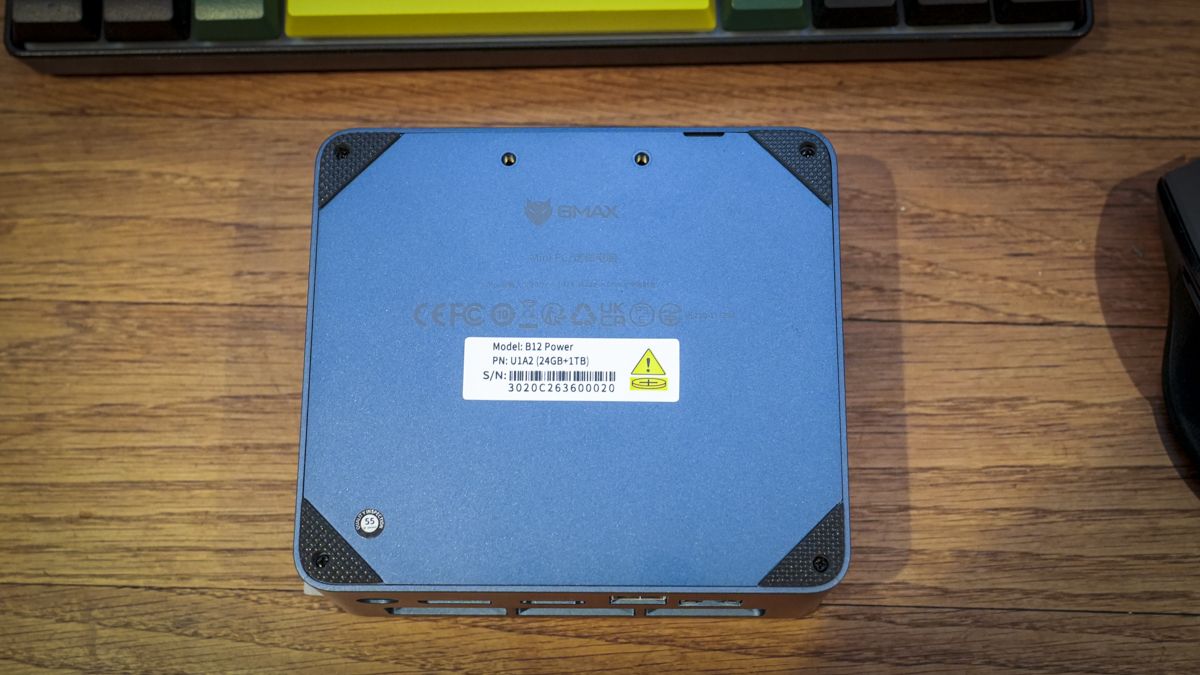
Access inside the machine is through four small screw holes in the corners of the base; once removed, they let you gently pivot the top up, revealing the inside.
The base is connected by a ribbon cable to the motherboard in the main chassis, and this enables a standard 2.5-inch SATA drive to be installed. BMAX doesn’t state the official maximum capacities for either the NVMe SSD or SATA drive. However, the ability to replace the SSD and add SATA storage provides useful expansion potential.
What also struck me about the design of the chassis is that there is a good amount of ventilation throughout, and during the test, the fans, while whirring up when the machine was under load during the benchmarks, remained quiet for the most part.
- Design: 4 / 5
BMAX MaxMini B12 Power: Features
At the heart of this machine is the Intel Core Ultra 9 185H, which features six performance-cores, eight efficient-cores and two low power efficient-cores. Hyper-Threading provides 22 threads and a maximum turbo frequency of 5.1GHz.
This CPU comes from Intel's Meteor Lake family, and when compared with the newer Panther Lake Core Ultra 9 386H, released in January 2026, there are some interesting differences. Machines featuring the newer processor can cost considerably more, depending on their configuration.
However, despite its age, the BMAX's processor actually features six Performance cores compared with the Panther Lake chip's four, alongside 22 threads rather than 16. Of course, the newer Panther Lake architecture is more efficient, so those additional cores and threads don't necessarily translate into better performance.
The major differences between the new and the old are increased NPU power and efficiency. The newer chips are far less power-hungry, making them better suited overall for these compact machines. Looking at the power consumption highlights the small machine’s potential, with a base processor power of 45W and a maximum turbo power of 115W.
What’s important is that this CPU features an integrated GPU, Intel Arc integrated graphics, with eight Xe-LPG graphics cores. This enables hardware ray tracing which is good for gaming and Quick Sync and modern video codec support, which help with file format compatibility with the latest cameras and applications.
The gaming performance section of the test highlighted this. However, this integrated GPU does share system memory rather than having dedicated VRAM, which, again, with only 24GB of RAM, can be an issue for some applications.
The processor is complemented by 24GB LPDDR5 4400MHz–5600MHz RAM and a PCIe 3.0 1TB NVMe M.2 SSD, with it being possible to upgrade the latter to a larger capacity. Then, as a bit of a surprise, there’s also a 2.5-inch SATA connection, letting you boost internal storage: use the SSD for fast access and SATA for slower archival storage.
Wireless connectivity is handled through Wi-Fi 6, which is a little older than most, and Bluetooth 5.2, again older technology but solid.
Cooling is a major part of all of these mini PCs, and the Space Capsule cooling system combines copper piping and a large fan with plenty of venting around the body.
The machine comes pre-installed with Windows 11 Pro, although you can install Linux Ubuntu or another OS if you wish.
As I scrolled through the features, one surprise was that the company listed this machine as waterproof, rustproof, and scratch-resistant. Looking at the build, I’m pretty sure this is a mistake, as the ports are all open, and at this price, if I submerge this machine in water, I’m sure it will be the last thing it does. Despite the image with water pooling on the top surface of the machine, there is no IP rating, so this appears to be an oddity of the marketing material.
For creatives, it’s great to see that two monitors can easily connect via the HDMI 2.1 and DP sockets at the back, enabling video at up to 4K/60Hz. If you want to add a third monitor, you can connect it through the front USB-C port.
The integrated NPU is less powerful than those found in the latest chipsets, but the combination of CPU and GPU still provides some potential for running local AI models. Larger models may be possible with appropriate quantisation, although the fixed 24GB of RAM will be a significant limitation.
The NPU is well-suited to many applications that support it. It also supports Intel’s OpenVINO ecosystem. This NPU is really at the start of mainstream AI integration, so while advanced at the time, it lags behind the latest options.
Looking at the features, this is a solid mini PC for general office use. The CPU, GPU, and NPU combination will provide the power, and a decent 2.5GbE LAN port supports its use better than many other entry-level mini PCs. Some newer features I’ve come to expect, such as USB4 and more advanced NPUs, aren’t obviously available, but for core traditional workflows, this machine should more than suffice.
- Features: 4 / 5
BMAX MaxMini B12 Power: Performance
CrystalDiskMark Read: 2,033.31 MB/s
CrystalDiskMark Write: 1,647.49 MB/s
Geekbench 6 CPU Multi: 11,777
Geekbench 6 CPU Single: 2,419
Geekbench 6 GPU: 28,132
Geekbench 7 CPU Multi: 12,797
Geekbench 7 CPU Single: 2,167
Geekbench 7 GPU: 22,540
PCMark Overall: 7,079
Cinebench R23 CPU Multi: 14,729
Cinebench R23 CPU Single: 1,797
Cinebench 2026 CPU Multi: 3,551
Cinebench 2026 CPU Single: 420
Fire Strike Overall: 6,462
Fire Strike Graphics: 6,908
Fire Strike Physics: 25,256
Fire Strike Combined: 2,486
Time Spy Overall: 3,344
Time Spy Graphics: 3,001
Time Spy CPU: 9,530
Wild Life Overall: 20,302
Steel Nomad Overall: 602
Sky Diver: Not recorded
Windows Experience Overall: 8.2
Procyon: 348
Removing the unit from the box, the small size and weight instantly highlighted that this would be a good option for mounting, and sure enough, in the box alongside the machine is a VESA mount, albeit just about as simple as you can get.
Plugging everything in, the port options are notably restrictive, with just the basics to get you going. The two rear USB 2.0 ports were used for the keyboard and mouse, while the monitor was connected through the rear HDMI port. Powering up, there were just a few final steps, which took a couple of minutes before launching into the main interface.
The first step in every test is moving the benchmark files to the machine, and I’ve got used to this taking a couple of minutes. However, here with the USB-C 3.2 Gen 2 connection, that download time from an M.2 SSD was notably slower. Once the files had downloaded and been installed, it was time for the real-world tests.
Instantly, I could feel a difference compared to some newer machines. Load times were a little longer, especially later in the test with the Adobe Creative applications and, particularly, the games.
For general productivity and Microsoft Office applications, Word, Excel, and PowerPoint ran well, and switching between them was smooth. In PowerPoint, I usually have both Photoshop and a browser window or two open, and again, the machine handled it all without issue.
One note: when opening Adobe Bridge, thumbnail rendering was a little slower than I have seen recently, but it was still respectable.
Looking more closely at Photoshop, that once-flagship CPU and GPU show just how much power they have available, and opening multiple images, adding layers and applying filters are all well within the machine’s capabilities. Likewise, while Photoshop handles images with ease, switching to Lightroom and opening a large library again shows the machine’s capabilities with both large JPEG files and RAW files from the Canon EOS R8 Mark II. Using Photoshop’s Neural Filters highlights the machine’s abilities, and while there is a wait for the effects to apply, it still handles the workload.
After Photoshop's impressive image handling, I switched to Premiere Pro, and again, the machine was more than capable of editing HD and light 4K video footage. However, when I loaded C-Log footage from the camera, I noticed a slowdown, so I transcoded the files in Adobe Media Encoder. Here, the lack of RAM really starts to matter, with Task Manager showing RAM topping out at 100%.
After some solid testing, I loaded Lemonade. I installed Qwen2.5-1.5B-Instruct and OpenVINO, and for a CPU of this age the chat response was fast and impressive. There were clear limitations, especially as I increased the token count. Checking the NPU usage, it appeared to be unused, so processing fell to the CPU and GPU. It’s good to see potential with the AI options, but this older CPU is unsurprisingly limited for newer workflows.
After the general administration and working tests, I moved on to two games: Cyberpunk 2077 and Indiana Jones and the Great Circle. After some slowdown in Premiere Pro, my initial thought was that the machine would struggle. However, both played well once they loaded. Indiana Jones definitely had the edge in smoothness, with some graphics glitches in Cyberpunk, but both ran surprisingly well with reduced resolution and graphics.
- Performance: 4 / 5
BMAX MaxMini B12 Power: Final verdict
As the test came to an end, this small machine had completely changed my initial impression. The fact that I’m looking at a new-to-market machine that’s sporting an almost three-year-old CPU, albeit a flagship, and with a plastic build and limited ports, did initially mean that I didn’t hold out much hope for the performance compared with the mid-range machines available at the moment.
However, it’s easy to forget just how powerful these older CPUs are, and while they may not pack the AI potential of the latest generation, they are still very viable options. As I ran through the test, I was repeatedly impressed by the performance. Microsoft Office and Adobe Creative Suite both ran quickly, and the only real slowdown came when loading creative applications with filters and effects.
There are, of course, limits, and the AI potential is the most obvious. While you can run a lightweight LLM, it’s not ideal, and that’s not due to the CPU but rather the 24GB of RAM. This doesn’t leave much headroom, and likewise, when editing video, if you switch to anything more complex than a direct 4K edit, you'll see the system strain again.
Then there’s the older PCIe 3.0 SSD, which, while still fast, lags what I’m used to in most mini PCs I’ve reviewed this year, with SSDs that hit at least three times that speed. On the flip side, you can upgrade to a larger SSD, and since it’s PCIe 3.0, a 2TB module will be cheaper than a PCIe 4.0 or 5.0 module. I also like that they’ve included the 2.5-inch SATA option, giving you the potential to expand storage well beyond the standard 1TB. However, BMAX hasn’t specified the maximum supported capacity.
Ultimately, you have a small, powerful machine that, while it may not use the latest components, still delivers excellent performance for most people looking for a compact mini PC for general, creative, and some gaming use.
Should I buy the BMAX MaxMini B12 Power?
Value | For the version I’ve looked at, it's good value. | 4.5 |
Design | The small size and design make it easy to transport or position when space is tight, although there is a slight lack of ports. | 4 |
Features | The CPU may be almost three years old, but it still packs serious levels of power, although there are limited upgrade options. | 4 |
Performance | All things considered, for a machine at this price and in the present climate, it’s capable of providing the power for administration, creative work and some gaming. | 4 |
Overall | That once-flagship CPU gives this mini PC plenty of power, and whilst the price is still high for what it is, much of that is no doubt due to current memory costs. | 4 |
Buy it if...
You need a compact Windows PC for office productivity and multitasking.
For Microsoft Office, this machine handles all applications with ease, plus Photoshop if you need some image manipulation at the same time.
You want reasonable integrated graphics for occasional creative applications.
Running Adobe Premiere Pro and some games, I was impressed by the power the Intel graphics could deliver. Whilst there are limits with a machine of this size, they are impressive.
Don't buy it if...
You require upgradeable memory or USB4 connectivity.
These can become an issue, especially the lack of USB4 for quickly transferring files to or from the machine.
You need modern NPU performance for demanding local AI workloads.
The NPU's power is now dated. Whilst you can run very small language models, newer models offer a significant uplift in AI potential.
For more professional-grade desktops, we've tested the best business computers.