Martian Mocha, Anyone? This Futuristic Coffee Machine Uses Nasa Data To Give You A Taste Of 3 Different Brews From The Next 100 Years
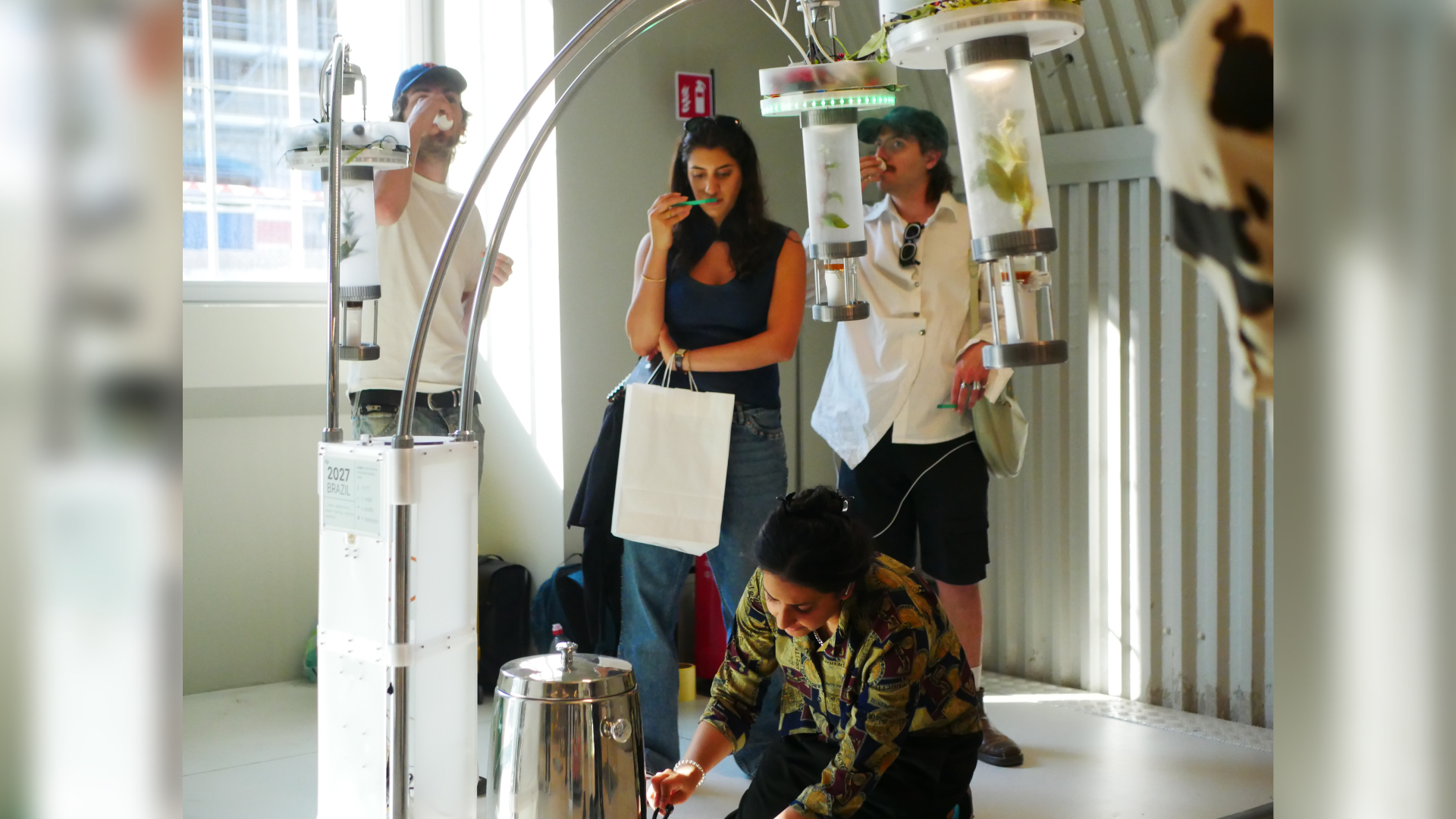
- A designer working with NASA and agricultural experts has created a coffee that tastes like it was grown on Mars
- MA student Sarah Ali created the coffee as part of her 'Brew_Lab' project
- The project reflects on how climate change might affect the availability and composition of coffee
A designer working with experts at NASA and the UK’s Royal Botanical Society has produced a coffee that tastes like it was grown on Mars a hundred years from now.
The red planet-flavored Mars 2126 coffee — an ‘edible scent’ added to a regular cup of joe — is a product of Brew_Lab, a project by industrial designer Sarah Ali. The project is centered around a futuristic vending machine that brews coffee from three different dates in the future, based on climate projections.
Ali, 35, produced Brew_Lab to conclude her MA in Material Futures at Central Saint Martins, University of the Arts London, and exhibited the project at Milan Design Week in April 2026, as well as CSM's degree show which runs until June 21.
“This is very much a climate futures project” said Ali to TechRadar, “and the way I got to Mars was through the fact that if we keep on doing what we do now, our future in 100 years time might be that Earth won’t be able to facilitate all the things we need it to.”
“It’s a little bit speculative,” she continued, “but what I found really cool was that people at NASA were already testing what food and drink would be like on Mars. There’s a lot of investment in that space.”
The Arabica successors
As well as providing passers-by the chance to try a cup of Martian mud from 2126, the project also includes an edible scent designed to predict the taste of coffee grown in Sierra Leone in 2080. This uses the revived stenophylla species of coffee bean, which is more resilient to climate change than the industry-leading arabica bean.
The third and final flavor, Brazil 2027, is used to emphasize the frailty of the Arabica bean, with crop yields expected to fall by as much as 80% by 2050 (via University of Florida).
To design the scent profiles of each coffee, Ali used machine learning models fed by data from NASA’s Dr. Gioia Massa, and Kew Gardens’ Dr. Aaron Davis, a world- leading coffee expert.
A post shared by Scentible (@scentible.co)
A photo posted by on
“Dr. Davis has studied 127 different coffee species, of which only 7 to 12 are likely to survive into our future” adds Ali. Brew_Lab uses rare, hardy racemosa beans for its Martian brew, and Ali explained that NASA’s research on agriculture allowed her to factor in the effect of gravity on our perception of taste on the final product.
“I thought of Mars because it’s a very extreme scenario”, Ali said, “and the extreme scenarios allow us to really understand what’s happening. How do we think about things differently, to avoid that future or prepare for it.”
Still, it might take a few years yet for the best coffee makers to add a ‘Martian’ setting.
Popular Products
-
 Professional Hair and Scalp Detection...
$1,765.99$1056.78 -
 Fairywill Sonic Electric Toothbrush Set
$148.99$103.78 -
 Electric Hair Straightener and Curlin...
$161.56$80.78 -
 High Tech Laser Therapy Watch For Hyp...
$536.99$374.78 -
 Wireless Health Tracker Smart Ring - R11
$131.56$65.78