Roborock Rockmow Z120 Lidar Review: Just The Ticket For Sprawling Lawns With Heavy Undulations
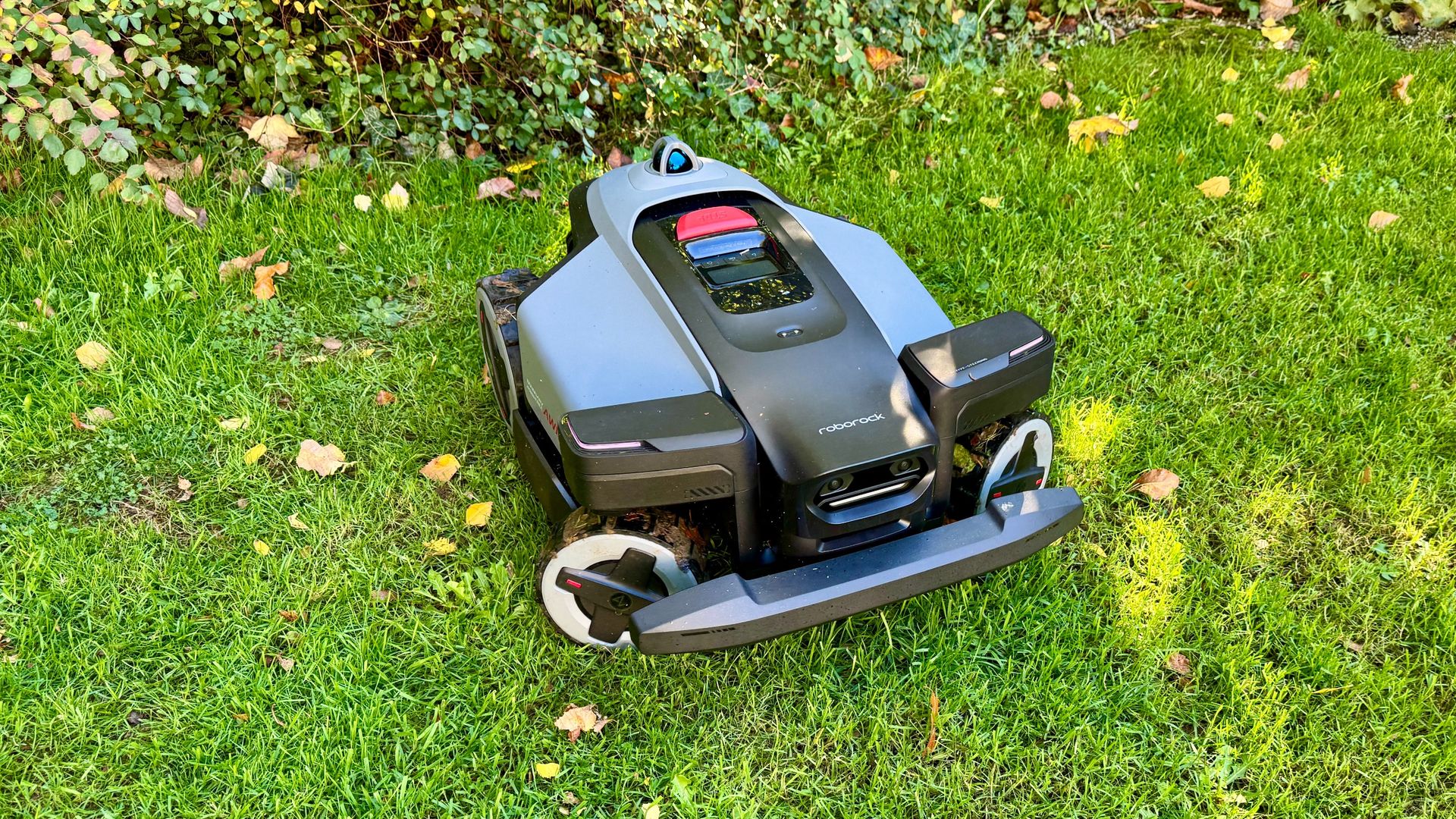
Roborock RockMow Z120 LiDAR: two-minute review
For a first timer on the sward, the new Roborock RockMow Z120 LiDAR has proven to be an extremely impressive piece of lawn-care engineering, combining sophisticated LiDAR navigation with a host of clever mechanical flourishes that give its competitors a very good run for their monies. But then one shouldn’t be too surprised by this, given that the Chinese behemoth is already such a well-established leader in the field of autonomous indoor floor cleaners.
The Z120’s rock-solid LiDAR and VSLAM navigation has worked wonders on my tree-lined lawn, while its ingenious front-wheel arrangement has enabled it to make tight turns without ripping the lawn to shreds. Add a proper suspension system, floating 24cm cutting deck and the ability to climb slopes of up to 80 degrees, and you have a wire-free mower that easily handles a myriad of lawn layouts.
Having spent some time with the RockMow Z120, it's difficult not to be impressed by the sheer amount of thought that has gone into its design. As a result, its accurate LiDAR navigation, impressive obstacle avoidance, clever front wheels, neat cutting results and insane ability to scale the steepest of slopes make this model a must-have for those with large lawns – and those who can afford the premium price tag.
Roborock RockMow Z120 LiDAR: price & availability
- How much does it cost? £2,299 / €2,799
- When is it available? Available now, launched May 2026 in UK
- Where can you get it? UK and Europe
The Roborock RockMow Z120 LiDAR is firmly positioned in the premium end of the robotic lawn mower market, and its price reflects the considerable tranche of technology on board, particularly its clever articulating front wheels.
In the UK, the Z120 LiDAR has an official retail price of £2,299 (about $3,030 / AU$4,500) with Roborock UK currently selling it for £2,069.10. However, I've also spotted it advertised for considerably less at Donaghy Bros where it’s selling for a knockdown £1,599.
Across Europe, the Z120 is called the Z1 and is generally marketed at around €2,799 — a whopping price to pay, and that’s without the optional PreciEdge side-cutting module which costs around €150. In the USA, the equivalent model is sold as the RockMow X1 LiDAR, with a recommended retail price of $3,199.
For a robotic mower, these are serious sums of money, but the Z120's sophisticated LiDAR navigation, four-wheel drive train, clever front wheel system and impressive cutting performance go some way towards justifying the investment.
Nevertheless, there are other all-terrain models out there that compete very favourably with the RockMow Z120 LiDAR, most notably the four-wheel-drive, LiDAR and RTK-equipped Mammotion LUBA 3 (£2,049), which has a much wider cutting deck but not as good a front-wheel drive system. Also check out the Segway Navimow i210E LiDAR Pro which comes with three-wheel drive, Xero-Turn and a cutting range of up to 1,000m².
Value score: 3 / 5
Roborock RockMow Z120 LiDAR: specs
Max lawn size | 2,000m² (0.49 acre) |
Navigation | Sentisphere LiDAR Environmental Perception |
Obstacle avoidance | 360-degree LiDAR + 2 Cameras |
Auto mapping? | Yes, AI powered |
Cutting deck width | 24cm (9.4 inches), six blades |
Cutting height adjustment | 20–70mm (0.78-2.75 inches), motorized |
Edge cutting? | Yes, optional module |
Drivetrain | Four-wheel drive + suspension |
Maximum slope | 80% / 39 degrees |
Mowing Time Per Charge | 110 mins |
Obstacle avoidance | V-SLAM + AI |
Rain sensor | Yes |
Connectivity | WiFi, 4G and Bluetooth |
Security | 4G real-time tracking, alarm plus PIN code |
Noise | 62dB |
Rain sensor | Yes |
Weight | 21.7kg (47.84lbs) |
Dimensions | 66.1 x 47.5 x 33.2cm (26 x 18.7 x 13 inches) |
Product code | RockMow Z120 LiDAR |
Roborock RockMow Z120 LiDAR: design
- Rugged looker
- Unique front wheel system reduces tearing
- Dependable navigation
Given Roborock’s leadership in the field of floor cleaning robotics — specifically in the navigation and obstacle avoidance departments — I can think of no better corporation to join the current throng of robot lawnmower manufacturers. In fact, in April 2025 I fired off an email to my contact at Roborock to enquire — off the record — whether the company would ever consider producing a robotic lawn mower. His answer? "I can't share anything about that... yet!"
Well, lo and behold, here they come — and the prognosis is good. Very good. For the record, in the UK where this review is being written, Roborock’s opening salvo of Euro-spec robot mowers is comprised of six core model variants across three product platforms — the RockNeo Q series, RockMow S series and RockMow Z series — with expanded options like the flagship LiDAR-equipped Z120 I’m reviewing here.
Despite being a highly-regarded robot vacuum cleaner manufacturer with a great reliability record, the company is facing stiff opposition from several established manufacturers like Segway, Mammotion, TerraMow, Worx, Anthbot and Husqvarna. On the other hand, garden robotics is still a relatively new industry, and it’s not like no one’s ever heard of Roborock. In fact, it’s quite likely that the company’s first swathe of interested parties will come from its own highly established user base. After all, if you’re happy with a brand, love its products and the app that runs them, why not stick with what you know?
The new Roborock RockMow Z120 LiDAR’s angular wedge-shaped body, prominent rear suspension springs, and chunky, deeply treaded wheels both fore and aft give it a rugged, almost miniature off-road vehicle appearance that I find very appealing. In fact, just lifting its substantial 21.7kgs (47.84lbs) of weight should reassure any new owners of rough, complex landscapes that they made the right decision.
While the Z120 doesn’t sport the wider cutting tract of Mammotion’s hardy LUBA series, I can see this model becoming an incredibly popular alternative, partly because of its four-wheel drive ability to scale steep inclines of up to 80%, but mostly because its front wheels independently articulate to near 90 degrees, enabling to make tight turns without churning up shady areas of the lawn.
Let’s look at this model in more detail.
Drive system
Roborock has addressed some of the complaints aimed at Mammotion’s LUBA range of mowers, which have fixed front wheels fitted with smaller omnidirectional spinners that allow the robot to make tight turns. The trouble with this system is that the spinners can quite easily loosen the earth around weaker grass stems as the robot turns on its axis, especially in shaded areas of the lawn. While I’ve never experienced any lawn scuffing, there are many LUBA users out there who have.
By contrast, the RockMow Z120's drive system combines four-wheel drive with independent wheel motors and a very clever active steering system that allows both front wheels to swivel independently through almost 90 degrees in either direction when turning. Hence, the Z120 can execute zero-turn maneuvers without dragging its tires across the grass and ripping out the roots. This is a particularly useful feature when navigating shaded tree areas, flowerbeds and obstacles like trampolines, while also minimizing turf damage on slopes.
The Z120’s four-wheel-drive system provides traction across all four corners, while the substantial rear wheels and independent suspension help maintain contact with even the most gnarly of ground. Believe me, this system works.
Furthermore, Roborock claims the Z120 can tackle gradients of up to 80%, equivalent to around 39 degrees, and negotiate obstacles up to 8cm high, which is something the vast majority of mowbots are incapable of. This unusually sophisticated drive arrangement shows that Roborock’s R&D department clearly followed the working methods of practically every other wireless robot mower on the market and found ways of circumventing most of the issues that have plagued some of its competitors.
By watching and learning — and holding back until it had perfected a drive system capable of meeting a wide variety of terrains — the Chinese robot vac manufacturer has burst out of the gates with a model that is near perfect when it comes to negotiating rough, wildly undulating terrain without destroying the very thing it was designed to maintain.
The RockMow Z120 LiDAR uses a 21.6V, 6Ah lithium-ion battery that provides up to 110 minutes of mowing on a single charge. Like all robot mowers, when the battery’s depleted it automatically returns to its charging station, with a recharge taking approximately 50 minutes. Roborock claims a daily lawn coverage of up to 2,000m² for this model — a substantial half acre — so it’s clearly aimed at the higher end of lawn ownership.
Score ref: 5/5
Cutting system
The Roborock RockMow Z120 LiDAR uses a single, centrally mounted 24cm cutting disc rather than the much wider twin-deck 40cm arrangement found on its closest rival, the Mammotion LUBA 3. Mind, 24cm of cutting width isn’t too bad for a single cutting disc model given that the norm is nearer 20cm. No, it won't create the appealingly wide cutting stripes of the LUBA 3 but the results are definitely better looking than the average 20cm model.
The Z120’s cutting system carries six spinning blades that are partly hidden behind an aluminum disc to help cut down on grass wrapping around the blades’ connecting screws and eventually causing the blades to jam — a common occurrence with other robot mowers. While six blades might not sound particularly generous for a machine aimed at larger lawns, you have to remember that robotic mowers are designed to deliver a consistent finish through regular, automated mowing two or three times a week, so having three more blades than the average bot can be considered a bonus.
Like all good lawnbots, the ZI20 is fitted with an electrically adjustable cutting height system that is accessed via the Roborock app. The cutting height ranges from 20mm to 70mm in 5mm increments, which covers practically every type of grass on the planet. And because the cutting deck is of the floating kind, it follows changes in ground level to maintain an even cut across uneven terrain.
One particularly useful feature with this machine is the optional PreciEdge side-mounted cutting module. This adds a separate, smaller cutting disc with two blades, allowing the mower to trim much closer to boundaries, walls and fences than the main cutting deck can manage.
The PreciEdge module is said to reach within 3cm to 5cm of an edge, although the actual result would depend on the boundary itself and if there are any overhanging plants. The PreciEdge side cutter is sold separately, mind, so you'll need to factor another £150 into the price if neat lawn edges are a priority.
Just be aware that the PreciEdge has a fixed cutting height of 40mm so if you’re in the UK and prefer a 30mm cut, you can expect the edges to be 10mm longer. Since my preferred sweet spot in the UK is 35mm, I’m not too fussed by the negligible 5mm difference in height between the main part of the lawn and the edges.
Score ref: 4.5/5
Navigation
Roborock is a past master when it comes to robot vacuum cleaner navigation so I expected rock-solid reliability with this model. I was right, because this mower has behaved superbly well on my modest 170m² lawn.
The RockMow Z120 LiDAR's navigation system uses Roborock's ‘Sentisphere Environmental Perception’ technology, which combines a 360-degree 3D LiDAR scanner with autonomous vehicle-style VSLAM (Visual Simultaneous Location and Mapping) and two cameras to build a detailed picture of its surroundings and determine its position, day or night.
Unlike conventional robot mowers that depend on satellite positioning using, in many cases, an RTK antennae spiked into the ground, this LiDAR version requires no such malarky. Instead, its rotating laser sensor continuously scans the garden, measuring distances to surrounding objects and using these measurements to establish its position, in much the same way as robot vacuum cleaners get about the house. This makes the Z120 particularly well suited to gardens with dense tree cover, shaded areas and complicated layouts where satellite signals are often unreliable.
Crucially, the Z120’s navigation system also supports systematic mowing rather than the random wandering associated with older robot mowers. Once the lawn has been mapped, the Z120 starts a parallel cutting route in any direction the user wants. This method ensures that the Z120 covers the entire lawn efficiently while leaving a consistent Wimbledon-like striped finish in its wake. In fact, I wager that it’s the pretty lawn stripes that has ultimately made the modern robotic lawn mower so incredibly popular. That and the huge amount of time it saves.
While I’m not sure how many different garden zones this model can handle, I have heard that it’s around 15 and that’s about par for the course. As with other models, you simply map two or three different lawns and join them all together virtually in the Roborock app by manually steering the Z120 from one lawn to the next. As long as there are no obstacles like stairs and gates en route, the Z120 will cut one lawn before following the path to the next zone, and so on and so forth.
Score ref: 5/5
Obstacle avoidance
The RockMow Z120 LiDAR employs an impressive obstacle avoidance system that’s designed to identify and negotiate the various hazards that inevitably litter a real-world garden, like toys, stray plant pots, hose sprinklers, etc. Using a combination of LiDAR and onboard VSLAM technology, it can detect most objects in its path and adjust its trajectory accordingly. A collision sensitive bumper adds extra peace of mind.
The Roborock app offers two main levels of adjustable obstacle avoidance sensitivity – Mowing Coverage Priority and Obstacle Avoidance Priority. If you have kids who may be on the lawn, you can also set Proximity Pause so the mower either avoids them or stops working altogether. And, like quite a few other models, this one also has a Wildlife-Friendly mode that stops operation during specified hours, which is usually during the night.
Score ref: 4.5/5
Security
The Roborock RockMow Z120 LiDAR has a pretty comprehensive anti-theft package, which is reassuring given that this is an extremely expensive piece of garden kit that’s usually left unattended outdoors.
That said, all modern robot mowers are indelibly linked to the owner’s account and Wi-Fi system so even if a thief were to steal it, it would basically be a brick. The trouble is that most thieves won’t know this so it’s still always a good thing to activate any security options in the app.
For the record, the Z120’s security features include a PIN code lock, a high-decibel alarm, and built-in 4G connectivity for real-time location tracking through the Roborock app.
The alarm can be configured to activate if the mower is lifted or moved beyond its preset virtual boundary, though I should add that I haven’t been able to lower the app’s default minimum of 100m on my test unit, which is way too far beyond its working perimeter for my liking. Perhaps a future update will allow for a shorter distance of, say, 25m
If the Z120 does go walkabout, you can check its location through the app and remotely activate the alarm to attract attention. Since the 4G tracking facility requires the mower to be switched on, Roborock has also provided a hidden compartment beneath the top shell for an additional third-party tracking device like an Apple AirTag, which provides another potential way of recovering it if stolen.
Score ref: 4.5/5
Design score: 4.5 / 5
Roborock RockMow Z120 LiDAR: performance
- Creates lovely lawn stripes
- Competent obstacle avoidance
- Effortlessly scales steep gradients
I apologize on behalf of the British weather this summer because, while a very long spell of hot dry weather in the UK is always welcome for most of us, this year’s series of heatwave followed by drought conditions turned the English landscape into the African bush veldt, making it nigh-on impossible for reviewers to accurately appraise most garden products. Thankfully rain did eventually arrive and the grass recovered to some degree so I could properly test this mower. Here are some of its most valid performance stats.
Setup
The RockMow Z120 LiDAR is a hefty brute of a mower, so you may need two to get it out of the box and carry it to where you plan to site the charging station — Roborock provides about 10m of cable to your nearest outdoor AC outlet.
Set up is extremely easy because it doesn’t involve staking in any ancillary RTK antennae. Instead, you simply position the charging base as advised in the manual, plug it in and roll the Z20 onto the charging pins. Now launch the Roborock app, tap + and follow the onscreen instructions for an extremely fuss-free set up.
Once activated, the first thing you’ll need to do is map your lawn for the first time, and you can do this in two ways — automatically or manually, by steering the Z120 around the perimeter of your lawn. Like all auto-mapping bots, the the Z120 will head out of its dock and proceed to hug the entire border of a lawn using both its LiDAR laser system and the two front-mounted cameras. Auto mapping is a good choice if your lawn has a simple layout and the borders don’t have any plants overhanging.
Like most reviewers, I personally prefer using the manual method since I can steer it more accurately along the border and under any overhanging foliage. This method should ensure that all future cuts are as close to the edge as possible. However, I should point out that the default steering mechanism uses just one multidirectional virtual joystick on the app instead of the normal two — one to move the robot forward and the other to make turns. I would suggest changing the single joystick to twin sticks in the app or you’ll be steering the robot all over the place and make a right hash of your first map.
Now your lawn is mapped, you can set the Z120 off on its first run. Just don’t forget to change the cutting height in the app to a higher setting if your grass is on the long side or it will leave a trail of ugly clippings behind. Once your first cut is complete, you can lower the cutting height to somewhere in the region of 35mm — the sweet spot for UK lawns.
Score ref: 4.5/5
Cutting and usability
When it comes to performance and day-to-day usability, the Roborock Z120 LiDAR has proven to be a remarkably accomplished piece of lawn-tending kit. Its navigation has been excellent on my admittedly simple lawn layout, with the mower confidently finding its way around the garden, negotiating boundaries and maintaining impressively straight, parallel cutting lines. The latter is particularly satisfying because, aside from ensuring consistent coverage, the neat, regimented passes have left some rather fetching lawn stripe in its wakes, and with no sign of any damage to my soft-soiled lawn when it's turning.
Obstacle avoidance is another major strength. In my test, the Z120 demonstrated an impressive ability to recognize and negotiate around a long sausage-like dog toy, a very small cast-iron duck ornament, and a small flower pot that that flummoxed at least two models I’ve previously reviewed. It has also gone about its business without requiring any supervision or intervention, which is precisely what you want from a machine that's designed to take the hassle out of lawn mowing.
I also tried the optional side-mounted edge cutter, which allows the Z120 to get considerably closer to lawn boundaries than most of the competition. It's a worthwhile, albeit pricy, addition though I will admit that it never quite managed to achieve a cut right to the very last few centimeters along the edge. In other words, don't throw away the grass trimmer just yet because you may still need it for the occasional bit of edge smartening.
I’ll sign off with a massive shout-out to the Z120’s genuinely astonishing four-wheel-drive ability to climb steep slopes. I tested it on an extremely challenging gradient consisting of damp early-winter earth covered in wet leaves — hardly ideal conditions for maintaining traction — and was amazed at how confidently it scaled the bank on four separate occasions.
As the accompanying video illustrates, the Z120 simply drove straight up the incline as though it were negotiating a level playing field. There was no hesitation, wheel spin or retreat back down the slope. It just flew up. For context, the Mammotion LUBA 3 also managed this same impressive feat, although my test of that mower was conducted on dry summer earth without the added complication of slippery, wet leaves. Top marks for this.
Granted, this is an extraordinarily expensive model for most prospective robot mower buyers and way too sophisticated for conventional lawnscapes. But if you have a large complex garden with surrounding trees and several steep gradients that’s in excess of 1,500m² (about a third of an acre) and the readies to match, I would wholeheartedly recommend this beast, mostly because it does the job and does it so well.
Score ref: 4.5/5
Performance score: 4.5 / 5
Roborock RockMow Z120 LiDAR: Roborock app
- Easy to navigate
- Excellent customisation
- Could do with a tweak or two
If you’re already a Roborock robot vacuum owner, you’ll already be familiar with the app that controls the Z120. That's a definite bonus in my book even though the interface is polished, intuitive, and refreshingly easy for a first timer to grasp. From mapping your lawn and establishing mowing zones to setting schedules, adjusting cutting preferences, creating no-go areas, and setting your own security measures, pretty much everything is accessible from your smartphone without the need for a degree in IT.
However, there are some areas for improvement, especially when it comes to the Z120’s mowing speed. At the moment its operational speed appears to be fixed to a medium-paced speed. I would like to see an option to change this to either slower or faster. Also, coming from the UK, I’d prefer to hear the robot’s voice notifications in an English-accented voice, as Roborock provides for its robot vac lineup.
App functionality score: 4 / 5
Should you buy the Roborock RockMow Z120 LiDAR?
Section | Notes | Score |
Value for money | While the Z120 LiDAR is an excellent performer, there’s no hiding the fact that it costs an arm and a leg. | 3/5 |
Design | In the pantheon of robotic mowbots, the Z120 ticks all the boxes, and then some. | 4.5/5 |
Performance | The Z120 LiDAR is a seriously well engineered model for effortless all-terrain lawn maintenance. | 4.5/5 |
App functionality | Although not perfect, the Roborock app is feature-packed and easy enough to navigate. | 4/5 |
Buy it if
Your lawn is large and/or steeply undulating
This model is a great choice for complex lawns and brilliant at scaling steep slopes
You don’t want your grass churned up
The Z120 LiDAR’s articulating front wheels ensure that tight turns don’t mess up the lawn
You have kids and pets
The Z120’s impressive obstacle avoidance vastly minimizes unwanted collisions
Don't buy it if
Your lawn is less than 1,500m²
This mower is overkill on smaller urban and suburban lawns
You’re fed up with trimming edges
The optional side cutter will help reduce the need for edge trimming, but it's not entirely successful
You’re on a tight budget
Premium pricing puts this model way beyond many budgets
How I tested the Roborock RockMow Z120 LiDAR
I had a very late start testing this model because it arrived in July, just as the UK drought of 2026 took hold and the grass almost immediately went dormant. Nevertheless, the rains eventually returned so I could finally get it on the lawn to put it through its paces.
As usual, I tested its mapping accuracy, noting how well it navigated my lawn, how well its six-blade cutting system performed, how efficiently it turned without ripping up edges of the lawn and how well it avoided obstacles. I’m pleased to say that, in most instances, it performed as well as the best models I’ve previously reviewed.
First reviewed November 2026
Popular Products
-
 Ai Dash Cam with Front & Rear HD, GPS...
$295.56$147.78 -
 Blind Spot & Lane Change Detection Ra...
$286.99$199.78 -
 Waterproof Multi-Sport Health Tracker...
$83.99$57.78 -
 Electric Blackhead Remover Vacuum Por...
$208.99$145.78 -
 Automotive CRP123X OBD2 Scanner Tool
$649.56$324.78