'we Know Who We Are': Small Cars Can Make Fiat Bigger Than Ever
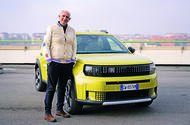
Fiat is back to its roots as a maker of small cars - Europe boss Gaetano Thorel unwraps the game plan
To become big again, Fiat had to embrace being small. That might sound counterintuitive but, after decades of struggle since its heyday as Italy's national car brand, Fiat has finally found a path back to success by doing what it has always done best: making small cars.
Think of any great Fiat and chances are it's small. Whenever the firm has tried bigger cars lately, it simply hasn't worked. So in recent years, revitalised as part of the Stellantis empire, it has leaned into what it does well. The 500e and Panda have been joined by the 500 Hybrid and Grande Panda, and even the Topolino quadricycle is selling well. Fiat's mantra now is "big in small".
That revival has been led by long-time CEO Olivier François — who was chosen by our editors for recognition at the 2026 Autocar Awards, and who earlier this week announced his departure from the role after 15 years. But the firm's Europe boss, Gaetano Thorel, has also played a key role. While François was about big ideas and marketing wizardry, Thorel's attention to detail and sales acumen shouldn't be underestimated. That might make him sound dry, but he speaks with passion, as evidenced by his often theatrical gestures.
This distinctly Italian spirit seems a spiritual match for Fiat. Yet despite that, Thorel actually spent more than two decades at Ford, joining what was then Fiat Chrysler Automobiles only a decade ago and taking up his current role in 2021. Still, he's clearly also proud of working for Fiat and his role in its recent revival.
"We've crossed the desert and we survived," says Thorel. "Now we want to put the Fiat brand where it deserves. It's a journey, but I'm extremely happy with where we're going. Fiat is the engine of Stellantis growth in Europe [now]. We're consistently selling more than 100,000 units a month."
That success is being driven by the Grande Panda, and Thorel notes the share of sales that are direct to consumers, rather than fleets.
"If you want to measure the strength of a brand, you look at the business-to-consumer (B2C) share, because those are the customers who choose a brand," he says.
So far this year Fiat is the fifth-best-selling brand in the European B2C rankings, up from 13th last year and Thorel notes that the UK has yet to really contribute, because of the delay in the Grande Panda going on sale in right-hand drive. But there's still room to improve.
"Are we perfect? No. I have higher expectations for the 500 Hybrid than we're delivering, but when you take a car out of the market for two years, it's more difficult to reinstate it," he says.
The 500 Hybrid shows how Fiat has flexed in recent years; the plan was for this generation of the city car to go electric-only and its petrol predecessor was discontinued. But when demand for the 500e didn't pick up as expected, Fiat reverse-engineered its platform to take a small petrol engine and a manual transmission.
The 500 has been such a success story for Fiat since its revival in 2007 that its popularity has overshadowed that of the brand itself. So the Grande Panda, built on Stellantis's cost-conscious Smart Car platform and reviving the spirit of another classic small Fiat model, is what has really driven the wider brand revival—and affirmed Fiat's small car specialism.
"We have two territories: small cars and light commercial vehicles," says Thorel. "For cars, the Fiat rules are clear: we go from 2.0 to 4.5 metres [in length]."
The Topolino sits at one end of that territory, and this year Fiat has revealed the car that will sit at the other end: the Grizzly, a new C-segment SUV that will rival the likes of the Dacia Bigster. Notably, the Grizzly wasn't initially developed with Europe in mind, but that changed during development as Fiat evaluated the market.
"Grizzly is the typical example of a project that Fiat can afford, because it's global and designed to compete in Turkey and Latin America, but it also has a space here in Europe to offer family transportation with a different formula," says Thorel.
Despite being close to 4.5m in length, the Grizzly uses the same Smart Car platform as the Grande Panda, and Thorel insists that "we will shock the market when we reveal the price". The Grizzly will be followed by a fastback variant, both of which will be offered with electric and hybrid powertrains.
Beyond that, the big challenge for Thorel is the successor to the Panda. It was launched way back in 2012 and is no longer even on sale in the UK, but it remains Italy's best-selling vehicle (where it's now marketed as the Pandina).
Thorel talks of his commitment to the "Panda population" to develop an affordable successor to keep buyers who are unwilling to go electric happy. It's no easy task: there has always been demand for small cars but their profit margins are tight. That's why so many rivals have given up on them. "It comes to the social role of a brand," he says. "We have a social responsibility in Italy, for sure, and Italy is the land of the small car."
That goes as far as pushing for any future Panda to be built in Italy, which Thorel notes "is probably not the best economic decision, but to me this goes beyond economic [factors]".
Those challenges in Europe are ones Fiat and Thorel face with purpose and a clear strategy: embracing the small to become big again.
"When you know what you stand for, everything is much easier," says Thorel. "We don't feel the need to do a D-segment car or the like, because Stellantis has sister brands for that.
"Fiat is not for everybody: we don't pretend to be. But we are the brand recognised for small cars - and that's enough."
WHY GRIZZLY IS ACTUALLY A CUDDLY BEAR
Grizzly bears famously are not cute and huggable: they're carnivorous and maul things, so you probably wouldn't want to annoy a hungry one. It is, as Fiat Europe boss Gaetano Thorel acknowledges, "technically an aggressive animal".
That has given Fiat a bit of a self-inflicted challenge: to make an SUV named after a pretty fearsome animal fit into a family of small, lovable cars. So why the name at all?
"It's the biggest member of the Panda family," explains Thorel. "We've got the Panda and the Grande Panda. What's the biggest bear above a panda? The grizzly.
"Now the challenge is to make the Grizzly a Fiat animal and sympathetic and smiling. But, trust me, you will see how we do that with our advertising."
Popular Products
No popular products available in this category.