Bmw Ix5 Hydrogen Moves Closer To Production As Fuel Cell Testing Advances
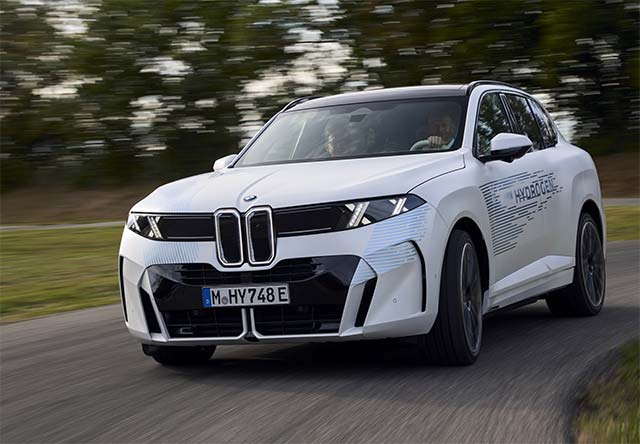
BMW is taking another major step toward bringing hydrogen-powered vehicles to series production, with the new BMW iX5 Hydrogen entering an important phase of development.
The automaker is currently testing iX5 Hydrogen prototypes under demanding conditions while simultaneously advancing production of its third-generation fuel cell system. BMW is also preparing its Steyr, Austria, facility for the future industrialisation and series production of the hydrogen powertrain.
The latest developments bring BMW closer to its goal of launching its first hydrogen-powered production vehicle, combining fuel cell technology with the driving characteristics expected from a BMW.
BMW iX5 Hydrogen Enters Intensive Testing
The current development programme focuses on validating the complete vehicle system rather than testing individual components in isolation.
BMW engineers are evaluating how the fuel cell, electric motor, high-voltage battery and other high-voltage components work together in different environmental and operating conditions. Particular attention is being paid to system control under high loads and maintaining consistent performance.
The goal is to deliver the driving dynamics associated with BMW while taking advantage of the characteristics of a fuel cell electric vehicle.
BMW says the current system integrates the fuel cell with its BMW Hydrogen Flat Storage, high-voltage battery and Energy Master, which acts as the central control unit for the vehicle’s high-voltage system.
The combination is designed to improve energy recuperation and overall efficiency. BMW is also targeting performance comparable to the battery-electric BMW iX5, including acceleration from 0 to 100 km/h in less than five seconds.
Third-Generation Fuel Cell System Moves Forward
While vehicle testing continues, BMW has started another prototype assembly phase for its third-generation fuel cell system at the company’s Hydrogen Competence Centre in Munich.
The latest phase is focused on refining testing procedures and preparing the technology for industrial-scale production.
Earlier prototype work concentrated on component manufacturability and the initial qualification of suppliers. The new stage is intended to help BMW establish reliable and efficient manufacturing processes before series production begins.
Future series production of the fuel cell systems is planned for BMW Group Plant Steyr in Austria.
BMW has already installed initial test benches and manufacturing equipment at the facility, while employees are being trained for the upcoming production processes.
The knowledge gained during prototype assembly in Munich is being transferred to the Steyr teams, helping BMW prepare for the eventual production ramp-up.
Hydrogen Could Complement BMW’s EV Lineup
BMW continues to pursue what it calls a technology-open approach to electrification, with hydrogen positioned as a potential complement to battery-electric vehicles.
Fuel cell vehicles could offer particular advantages in applications where long driving range, rapid refuelling and vehicle versatility are important.
BMW is targeting a range of up to 750 kilometres (WLTP) for the iX5 Hydrogen, while hydrogen refuelling is expected to take less than five minutes.
Like a battery-electric vehicle, the BMW iX5 Hydrogen drives using an electric motor and produces no tailpipe CO₂ emissions during operation.
The technology could therefore provide another route to locally emission-free transportation without relying exclusively on large battery packs.
BMW iX5 Hydrogen Could Mark a New Chapter
The latest testing and manufacturing preparations suggest that BMW is moving beyond simply demonstrating hydrogen technology and is increasingly focused on making it suitable for series production.
The challenge will be combining fuel-cell efficiency, fast refuelling and long-range capability with the performance, refinement and driving dynamics expected from a modern BMW.
If development continues as planned, the iX5 Hydrogen could become an important milestone for BMW’s electrification strategy and demonstrate how hydrogen can coexist with the company’s growing battery-electric lineup.
For now, BMW’s focus remains on validating the complete vehicle, refining its third-generation fuel cell technology and preparing the production infrastructure needed to take hydrogen mobility from prototype development toward the road.
The post BMW iX5 Hydrogen Moves Closer to Production as Fuel Cell Testing Advances appeared first on Electric Cars Report.
Popular Products
No popular products available in this category.