Can Byd Beat Renault? £26k Dolphin G Phev Takes On Clio
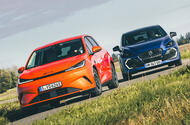
BYD's smallest PHEV is an intriguing new kind of supermini. Can it topple a fresh but familiar Clio?
For a market segment that emissions and safety requirements were supposed to have driven into oblivion by now, the European supermini class seems to be in rude health.
Four superminis in particular retain spots in our continent's top 10 best-sellers chart, which is proof that the appetite of European drivers for compact, efficient, well-priced cars, fundamentally straightforward in outlook and primarily petrol-fuelled, is ready to withstand almost anything.
The Renault Clio is one of those four (along with, for the record, the Dacia Sandero, Peugeot 208 and Opel/Vauxhall Corsa). Its success so far this year has been fuelled by the introduction of the sixth-generation version, which we're about to get to know a bit better.
The Clio has had to adapt to survive—to grow, mature and electrify—since the original model sashayed onto the scene back in 1990. Yet somehow it remains the closest thing the class has to an archetype. The defining and enduring, sophisticated yet simple, universally appealing and successful small European hatchback.
Today, in Denmark, we find out what chance it has of surviving its next existential threat. To date, the Chinese manufacturers that have been rapidly establishing their presences in various key European territories—chiefly the UK—have focused their attention mostly on bigger cars. There have been few serious Chinese tilts at fighting Europe's true heavyweights: its best-established, best-loved miniature heroes.
The BYD Dolphin G, however, is clearly a very serious car. This is a European-style supermini, made in China for now but destined for BYD's new factory in Hungary, with a brief to take on the indigenous population. And—spoiler alert—it's a rather good one.
First impressions
The Mk6 Clio has been on sale in Europe since the beginning of 2026, but won't arrive in the UK until early 2027. It's slightly longer and wider than the Mk5 we have now, on a longer wheelbase but using the same CMF-B platform. More interesting still, to us, is its altered, coupé-aping roofline and raked rear window; its slightly mean, pouty expression; and the fact that Renault uses words like 'technical' and 'resolute' to describe it. This is a Clio that Renault wants you to admire and desire—but categorically not because it's bonny or cute.
The Dolphin G is nearly 50mm longer but, more strikingly, 150mm taller than the Clio, and a lot less rakish. In its detailing, it's fairly sophisticated: a lot more so than the unrelated, fully electric Dolphin supermini of 2023. But in its overall shape, it's still like the kind of superminis that Europe was buying a decade or so ago: slightly tall and gawky but smart—and friendly-looking, just a bit MPV-influenced and not especially stylish.
It looks a little as if BYD split the difference between two design proposals: one bold and distinct, the other just a boil-washed, hatchback take on a Seal or Sealion. Like they couldn't quite understand the concept of putting so much unique personality into something so little.
I think it's fair to record that you might well buy the new Clio just for the way it looks—if it happens to be to your taste. With the Dolphin G, you still probably won't—but, to our eyes, it's well past the threshold of respectability.
Under the bonnet
This wouldn't be 2026 if we weren't talking about electrified powertrains—Renault will offer the Clio with a conventional 1.2-litre three-cylinder turbo petrol engine and a manual gearbox, if you would prefer one, but it expects the majority of buyers to choose a full hybrid, like our test car.
While the Mk5 Clio E-Tech uses a 1.6-litre engine, the new one moves to a 1.8-litre petrol motor and a bigger battery, with power swelling from 141bhp to 158bhp. Renault's innovative '4x2-speed', hybrid-specialised, clutchless automatic gearbox is carried over, though, as is the 48bhp main electric motor.
As we know from other Renaults, this is the kind of hybrid system that can run for short periods on electricity alone (at low speeds in town or maintaining a modest cruising speed out of town) but depends on its reciprocating pistons when there's meaningful work to be done. Which is to say nothing of the main technical difference between these cars: the Dolphin G can be plugged in and the Clio can't.
Using a high-compression, Atkinson-cycle, 1.5-litre petrol engine as a back-up and a generator, the Dolphin G's 161bhp main electric motor powers and drives it the vast majority of the time. And, in tandem with the 18.3kWh battery fitted to middle- and upper-tier models (compatible with both AC slow and DC rapid chargers), that means you can drive on electricity alone for 65 miles.
Yes, in a supermini. I would love to know how many superminis travel farther than 65 miles a day on average, but my guess is that 5% would be a very generous estimate indeed.
Is it fair to treat these cars as rivals, then? It's a reasonable point, albeit a redundant one, because right now there's no such thing as a PHEV supermini class in Europe. The Dolphin G becomes the only car of its kind with genuine, meaningful, home-chargeable, electric-only running. The closest things we've had to it have been range-extender EVs in the BMW i3 REx and Mazda MX-30 R-EV, both now departed.
Value for money
And then there's the price. You would expect a PHEV to cost more than a 'self-charging' hybrid, whichever class of the car market you happened to find it in. Sure enough, the Dolphin G will probably cost more than the Clio on strict like-for-like terms. But, while prices for the 2027 Clio are still to be announced, Autocar's sources suggest that Renault will probably hike those of the 2026 version by around £1000-£1500.
Which will put a range-topping Clio Esprit Alpine, very much like the one we've got here, within £1000 of a mid-range Dolphin G DM-i Boost—and could even make it more expensive on like-for-like monthly finance.
Away with any lingering doubts, then. Renault better consider itself on notice: these two cars are absolutely competing for the same money. And BYD is competing pretty hard.
On the inside
Two minutes spent hopping between seats confirms that the Dolphin G is the more spacious of the two cars here. Since it's the larger one, it ought to be. The difference isn't huge. To some people it won't be decisive either. But it's there.
Up front, for instance, there's plenty of space in both cars. The Clio's primary seat is set lower, the driving position better ergonomically, while in the Dolphin G you sit slightly higher and a little more over the controls.
But, perhaps because of its higher hip point, the Dolphin G is the kind of car in which an adult could travel in the back pretty comfortably, it having clear advantages over the Clio in terms of both leg and head room.
In the boot, meanwhile, the Dolphin G's practicality advantage is even clearer: 425 litres under the window line plays 309 litres, the Clio's carrying capacity still suffering significantly for the space taken by its hybrid system. Somehow the BYD packages a far larger drive battery yet compromises far less.
Is interior quality on the European car's side? Better check those preconceptions (the Clio, incidentally, hasn't been made in France since the turn of the decade; it comes to us from Bursa, Turkey, these days). Renault claims to have made this a real area of focus for the Mk6 Clio but, ignoring the material adornments of our test car (some Alcantara on the dashboard and door panels, a flashy-looking colour-fade foil running behind the steering wheel and some conspicuous coloured ambient lighting), I don't think you would know it.
The fascia rolltop is hard and shiny and the door mouldings are similarly cheap-looking. There's quite a lot of nasty gloss black plastic around the cockpit to smudge and mark and, besides a few nicely finished switches, not a great deal that feels solid or inviting to the touch.
The Dolphin G's decor is more monotonous and the atmosphere a lot less racy, but the actual built-in material quality is much better. At a background level, the moulded plastics, up high and down low, are more consistently well finished and solid-feeling. The fixtures and fittings, from door-release pulls to window switches to column stalks, all feel heftier.
There's very little colour or imagination on show; BYD has simply reproduced much the same silvery-chrome, bridge-of-the-Starship-Enterprise ambience that so many of its cars have. Its achievement is in having managed that, however, in a car that's still priced to cut through.
And it lends the Dolphin G an aura of big-car refinement that, by and large, its driving experience capitalises on.
On the road
You could argue that the car's main dynamic strengths (comfort, isolation and drivability) are a bit misplaced in a supermini and that buyers tend to want something more spirited and fun—like the Clio, at least in some ways. But the Dolphin G is a pretty rounded car to drive and doesn't make you feel at all like either its ride or its handling is the catch that you've been waiting to find. It just drives, and perfectly nicely at that.
The bottom lines are starker than you might imagine. BYD's hybrid powertrain is quieter, better-mannered and more pleasant than Renault's, but it also feels a lot more responsive and powerful. The Dolphin G's ride is also quieter and plusher than the Clio's (although the fitted alloy wheels of our particular test cars, at 16in versus 18in, will have played a part in this, and you will doubtless be able to have smaller ones on your Clio if you prefer).
On the road, the Clio isn't easy meat. It's notably the better-handling, sweeter-steering, more dynamically vivacious supermini of the two. It grips and corners in a way that escapes the Dolphin G, which rolls and floats just a little when it has to change direction and can't quite hide the extra mass that it's carrying.
Renault has at least tried to meet the classic supermini brief, then to make the Clio the zesty, agile, light-footed modern small car that most would want it to be. But, whereas the Dolphin G's hybrid system lifts it up and makes it surpass your expectations in so many ways, the Clio's hybrid system sells it short.
Put your foot down in the Dolphin G and you're away in an instant, the electric motor always primed and the engine rousing itself only in the background when needed. Do the same in the Clio and you have to wait a second or so for the multimodal gearbox to shift and for the rather noisy 1.8-litre engine to rev—only to be met with what feels, by comparison, like a pretty coarse and underwhelming style of delivery.
We will ignore the argument in favour of the Dolphin G concerned with significantly reduced running costs and electric running powered by special-tariff home charging, as transformative and convincing as that may be, because it would also be to unfairly mark down the Clio, which isn't a PHEV and never set out to be one.
The fact is that it's bested by the Dolphin G in too many and quite varied ways to finish anywhere other than second place here.
On another day, with a simpler powertrain, a manual gearbox and a lower price, the Clio might have better asserted its pedigree. It might do yet. Europe still has a lot to teach the rest of the world about the art of the small car and China still has much to prove.
Hybrid for hybrid, though, Shenzhen has beaten Paris in this particular struggle for a key supermini-class battleground. Europe's supermini archetype has been deposed—and doesn't that feel like a watershed moment?
Verdict
1st. BYD Dolphin G DM-I Boost
Smooth, spacious and well-built; the Dolphin G is a supermini with a real breadth of ability. It might not be a looker, but Shenzhen's new supermini excels on the inside and on the road.
2. Renault Clio Full Hybrid E-Tech 160 Espirit Alpine
Beneath the chic exterior lies a slightly lethargic hybrid powertrain - it's by no means a bad small car, but the Clio comes up short here in hybrid form. We suspect the 1.0 turbo petrol version, due in showrooms next year with the option of a manual 'box, will be a much better drive.
| Specification | BYD DOLPHIN G DM-i BOOST | RENAULT CLIO FULL HYBRID E-TECH 160 ESPRIT ALPINE |
|---|---|---|
| Rating | 4/5 stars | 3.5/5 stars |
| Price | £26,990 | £26,000 (est) |
| Engine | 4 cyls in line, 1499cc, plus ISG and electric motor | 4 cyls in line, 1789cc, plus ISG and electric motor |
| Power | 209bhp | 158bhp |
| Torque | 89lb ft (engine), 155lb ft (motor) | 199lb ft |
| Gearbox | 1-spd reduction gear, FWD | 4-spd/2-spd auto (engine/motor), FWD |
| Kerb weight | 1555kg | 1296kg |
| 0-62mph | 8.3sec | 8.3sec |
| Top speed | 112mph | 112mph |
| Battery | 18.3kWh (total and usable), LFP | 1.4kWh (total and usable), NMC |
| Economy | 202mpg | 72.4mpg |
| Electric range | 65 miles | na |
| CO₂, tax band | 32g/km, 10% | 89g/km, 23% |
Popular Products
No popular products available in this category.