Fidelity’s 2026 Retirement Study Says 7-in-10 Americans Would Skip Traditional Retirement For Gig Work, A Business, Or A New Career
The post Fidelity’s 2026 Retirement Study Says 7-in-10 Americans Would Skip Traditional Retirement for Gig Work, a Business, or a New Career appeared first on 24/7 Wall St..
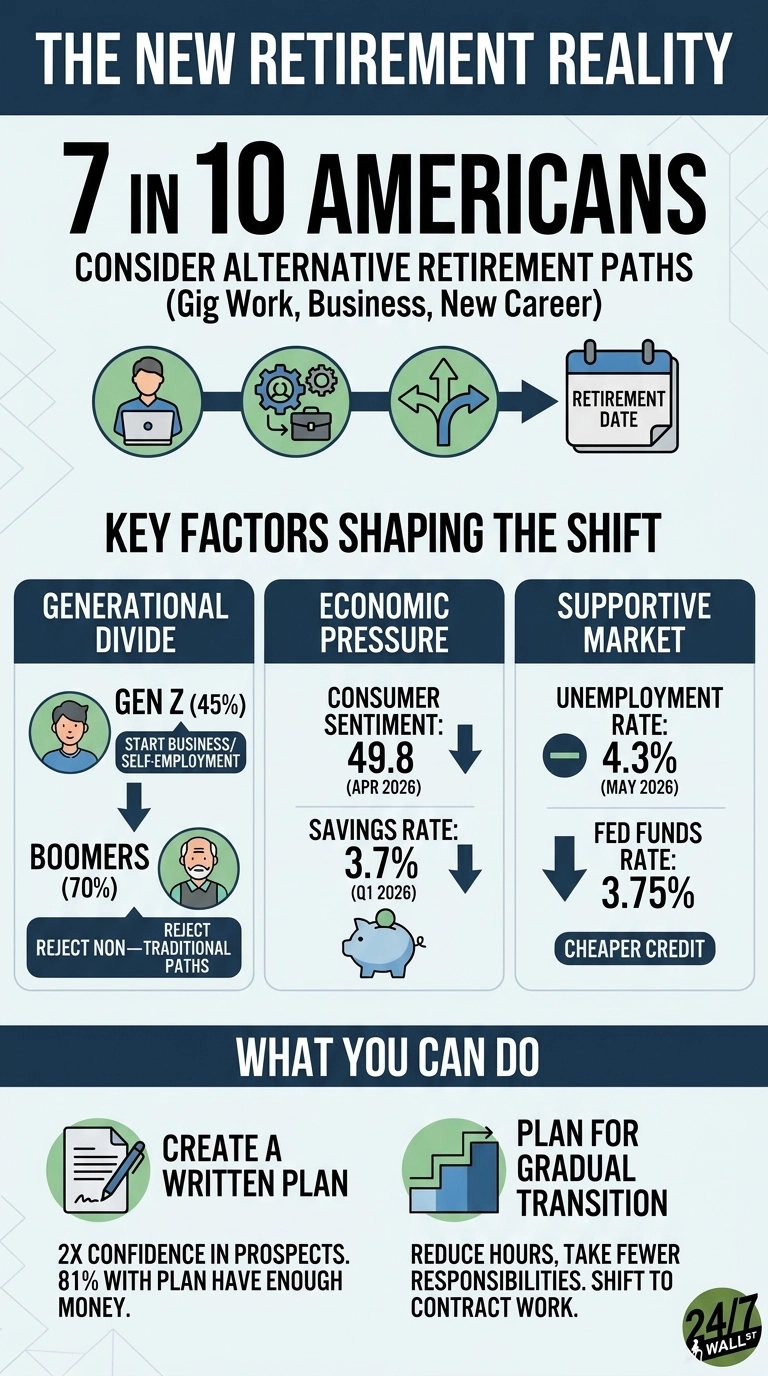
- Seven in ten Americans now consider non-traditional retirement paths like gig work, self-employment, or career changes instead of the traditional mid-60s full exit.
- Gen Z leads the shift with 45% planning to start their own business during retirement, while 70% of Boomers reject alternative work paths entirely.
- Six in ten Americans now plan a gradual transition into retirement through reduced hours and part-time work rather than a single fixed retirement date.
- Americans with a written retirement plan are more than twice as likely to feel confident about their financial security in later years.
- Gen X tops gig work interest at 43% while peak-earning years coincide with shaping retirement through side income and freelance opportunities.
- Cheaper borrowing costs and a steady 4.3% unemployment rate make starting a small business or pivoting careers more financially feasible than before.
- The personal savings rate has compressed to 3.7% in early 2026, pushing workers to seek alternative income sources as traditional retirement funding tightens.
- Eighty-one percent of retirees with a written plan report having enough money to last their lifetime, versus just 45% without one.
- Are you ahead, or behind on retirement? SmartAsset's free tool can match you with a financial advisor in minutes to help you answer that today. Each advisor has been carefully vetted, and must act in your best interests. Don't waste another minute; learn more here.
Fidelity’s 2026 Retirement Study describes a meaningful shift in how Americans picture their later working years. The traditional model, in which workers fully exit the labor force in their mid-60s, is becoming less common. Seven in ten Americans told Fidelity they would consider an alternative to traditional retirement, whether that means gig work, starting a business, consulting, or moving into an entirely new career. Retirement is increasingly described as a transition rather than a stopping point.
In addition, 45% of Gen Z respondents said they would consider starting their own business or pursuing self-employment as part of their retirement plan, the highest share of any generation for any alternative path. Only 10% of Gen Z said they would not consider an alternative at all, compared with 70% of Boomers who prefer sticking entirely to a traditional path. For workers who are decades away from a conventional retirement date, the idea of building something of their own is already baked into how they think about their long-term financial lives.
What Each Alternative Path Looks Like by Generation
Gen Z’s interests extend beyond entrepreneurship: 31% want to pursue a different career path, and 32% are drawn to consulting or part-time work. Millennials closely trail behind in ownership, with 42% interested in running a business and 37% in gig work. Gen X stands out for side income, posting the highest reading on gig work and side hustles at 43%, which fits a generation in peak-earning years that is still actively shaping its retirement balance sheet. Boomers remain the outlier, with only 4% interested in business ownership and 3% in a career change.
The transition itself is being redefined, with six in ten Americans now planning a gradual transition into retirement rather than a fixed retirement date. The specific strategies cited include reducing hours (34%), taking on fewer responsibilities (30%), shifting to freelance or contract work (18%), and simply continuing to work as normal (32%). Retirement is increasingly structured as a phased reduction in work rather than a single end date.
The Economic Backdrop Behind the Shift
Several macro readings help explain why workers are reaching for more flexible models. University of Michigan Consumer Sentiment sits at 49.8 as of April 2026, down from a 12-month high of 61.7 in July 2025. The personal savings rate has compressed from 6.2% in early 2024 to 3.7% in the first quarter of 2026, even as per capita disposable income has climbed to $68,359. Wage growth has remained steady, with average hourly earnings reaching $37.53 in May 2026, up from $34.89 two years earlier.
The labor market itself is supportive of alternative paths. Unemployment has remained in a narrow band, at 4.3% in May 2026 and within the 4.1%-4.5% range over the past 12 months. The federal funds rate has eased to 3.75%, down from 4.5% a year ago, which reduces borrowing costs for anyone considering a small business loan. A steady job market combined with cheaper credit makes the math behind a side venture or a career pivot more workable than it was 12 months ago.
Planning Is the Quiet Variable
The Fidelity data also points to a clear advantage for households that put a written plan in place. Americans with a retirement plan are more than twice as likely to feel confident about their retirement prospects. Among retirees, 81% with a plan report having enough money to last their lifetime, compared with 45% without one. As retirement becomes a multi-phase project that may include a business, freelance income, or a second career, the planning gap grows in importance.
What the Data Suggests
The cultural shift away from the hard-stop model is most evident among younger workers, but it affects every generation. Gen Z is leaning into ownership; Millennials are mixing entrepreneurship with gig income; Gen X is using side work to reinforce the balance sheet; and a sizable share of Boomers is choosing reduced hours over a clean break. For a growing share of Americans, the traditional retirement date has become one option among several rather than the default.
If You’ve Been Thinking About Retirement, Pay Attention (sponsor)
Retirement planning doesn’t have to feel overwhelming. The key is finding expert guidance, and SmartAsset’s simple quiz makes it easier than ever for you to connect with a vetted financial advisor. Here’s how:
Answer a Few Simple Questions.
Get Matched with Vetted Advisors
Choose Your Fit
Why wait? Start building the retirement you’ve always dreamed of. Get started today! (sponsor)
The post Fidelity’s 2026 Retirement Study Says 7-in-10 Americans Would Skip Traditional Retirement for Gig Work, a Business, or a New Career appeared first on 24/7 Wall St..
Popular Products
-
 Classic Oversized Teddy Bear
$23.78 -
 Gem's Ballet Natural Garnet Gemstone ...
$171.56$85.78 -
 Butt Lifting Body Shaper Shorts
$95.56$47.78 -
 Slimming Waist Trainer & Thigh Trimmer
$67.56$33.78 -
 Realistic Fake Poop Prank Toys
$99.56$49.78