Zohran Mamdani Is Trying A Fresh Tactic With Trump
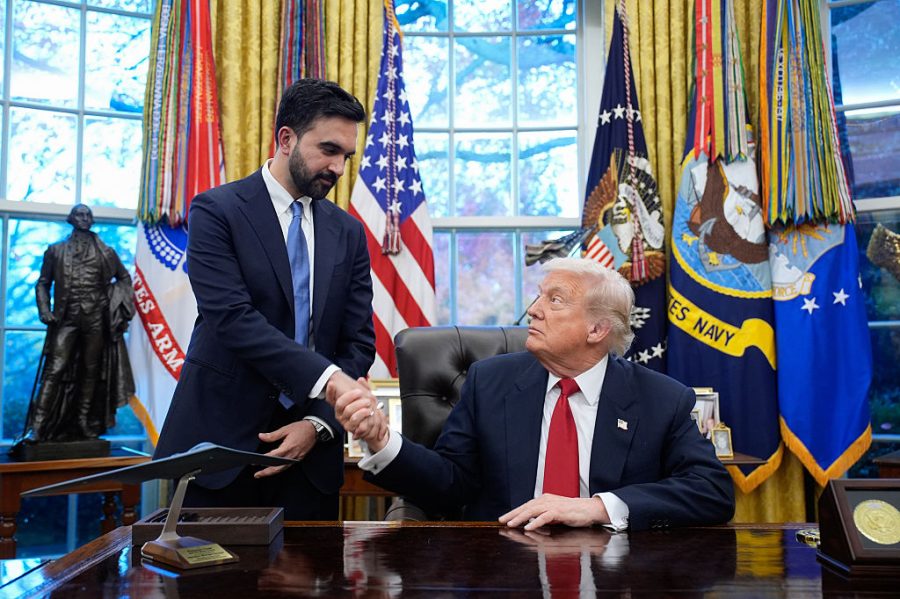
Donald Trump and Zohran Mamdani met for a second time on Thursday. The meeting was conciliatory, with Mamdani having apparently hypnotized Trump with charisma and overt flattery. It’s both a savvy and potentially perilous strategy.
On Thursday, New York City mayor Zohran Mamdani attended the White House to meet with President Donald Trump for a second time. Afterward, his administration posted an image so surreal it was hard to believe it wasn’t AI. In it, Mamdani stands behind Trump, who beams and holds up two newspaper covers. One, a real headline from the New York Daily News in 1975: “Ford to City: Drop Dead.” Another, a prospective headline the Mamdani team mocked up to show how Trump might be popularly received if he agrees to support Mamdani’s plans to build more housing for New York City, reads, “Trump to City: Let’s Build.”
Mayor Mamdani won his election last fall on a promise of affordability, not least of all in housing. Central to his platform is a plan to build two hundred thousand new units of publicly subsidized, union‑built, rent‑stabilized housing to increase supply and bring down costs. To accomplish this task, Mamdani needs cooperation from the Trump administration, which must authorize tens of billions in housing grants and financing reforms for large, new, affordable developments. Mamdani met with Trump on Thursday to discuss his proposed Sunnyside Yard project, which, at over twelve thousand units, would be the city’s largest build in half a century.
To get Trump on board, Mamdani opted to demonstrate what fruitful cooperation would do for Trump’s reputation and legacy. The original headline, “Ford to City: Drop Dead,” refers to President Gerald Ford’s veto of a federal bailout for the struggling city government, a central piece of the New York City fiscal crisis of 1975 that soon led to brutal austerity across the city and became a blueprint for neoliberalism as a whole. If Ford is remembered for gutting New York, Mamdani implied, Trump can be remembered for revitalizing it.
It was a smart appeal to Trump, a New York real estate developer at heart who longs to be the toast of the town. Mamdani was tapping into the same impulse that led Trump last year to impose himself on the federally run Kennedy Center for the Performing Arts, pushing the board to rename it in his honor. Judging by Trump’s beaming grin, Mamdani’s angle seems to have been effective.
In a phone call after the meeting, Mamdani made another ask of Trump. Earlier that day, an international student at Columbia, Elmina Aghayeva, had been detained by Immigration and Customs Enforcement (ICE) agents, who misrepresented themselves to gain access to university-owned housing. Mamdani also asked that the administration ease up on four other international current or former Columbia students — Yunseo Chung, Mahmoud Khalil, Leqaa Kordia, and Mohsen Mahdawi — who were targeted after participating in Palestine solidarity campus organizing. ICE released Aghayeva from custody shortly thereafter.
Friction on the Left
Many greeted Mamdani’s second meeting with Donald Trump with delight, hailing him as a strategic genius who knows how to manipulate Trump by flattering his ego. The New York Times called Mamdani’s maneuver a “master class in political psychology.” Leftist memes affirmed his savvy:
So good. Forever will be baffled by how more people never figured out how to play Trump like a fiddle. pic.twitter.com/XvSAH7NkG5
— Jon Niconchuk (@JonNiconchuk) February 26, 2026
the shit zohran did to trump in their meeting pic.twitter.com/7pRIUDk0Zr https://t.co/DrKC0KbPDa
— M1das (@M1das_OW2) November 22, 2025
Many commenters remarked on Trump’s apparent profound admiration for Mamdani. Indeed, as he set out to slander the “communist” Mamdani during his State of the Union address on Tuesday night, Trump appeared to become sidetracked by his affinity for the magnetic younger politician. In response to the image of Trump holding up Mamdani’s newspaper props, one popular post on X suggested that Mamdani is better-liked than Trump’s own children, speculating that “Eric Trump has never seen that smile in his life.”
Others on the Left were uneasy with Mamdani’s friendliness to the president, suggesting his conciliatory posture normalized a profoundly abnormal and dangerous presence in American politics. This criticism echoes objections raised after Mamdani’s first meeting with Trump last year, which likewise resulted in a joint press conference in which the two appeared sociable. In the photograph Mamdani’s team posted on Thursday, the mayor’s usual smile is replaced by a notably muted expression — perhaps an effort to tone down the chumminess. Mamdani remains highly critical of Trump in other settings, calling him a fascist two days after their first meeting and continuing to vocally oppose the administration’s actions.
The Left’s competing responses to Mamdani’s strategy vis-à-vis Trump raise an important strategic distinction. One side’s argument goes like this: Politics is more than just showcasing principles. It requires making real things happen to shift the balance of power, which often requires coordinating with opposing parties. Mamdani has a chance to materially improve working-class people’s lives in America’s largest city and needs to do so if he is to be seen as a successful mayor. Not only do ordinary people deserve that relief, but if he pulls it off, he will set a living example that can rescue socialism from irrelevance. This achievement will be far more impactful than the optics of protesting the president at every turn.
The other side: Donald Trump poses a historic threat to the direct safety of millions of people and to the democratic institutions holding society together. The Left’s most popular figurehead being interpersonally friendly and cooperative rather than combative with Trump in public aggrandizes and legitimizes him, with potentially disastrous consequences. If the United States tips over into unmitigated fascism, no amount of affordable housing will have been worth it. Politics is a long game, and victory over Trumpism requires a tribune willing to relentlessly agitate the public against Trump himself, even at great personal cost.
Every leftist errs on the side of either sectarianism or opportunism. We should guard against both. But in practice, we can’t operate decisively without consciously or unconsciously privileging one aspect. Mamdani has made it clear that he’d rather err on the side of instrumentalism than pure principle.
It’s easy to see why. We have a socialist mayor in the country’s largest city — at the same time we have a right-populist authoritarian in the White House. Trump holds far more power than Mamdani, and the mayor needs some level of cooperation from Trump to deliver on major campaign promises like affordable housing, without which his mayoralty will likely be seen as a failure. (A similar dynamic is at play in Mamdani’s tightrope act with New York governor Kathy Hochul.)
And cooperation isn’t mutually exclusive with conflict. In this case, Mamdani successfully negotiated for federal housing funding while also reversing a particularly egregious case of ICE thuggery in the streets of New York and emphasizing his opposition to the Trump administration’s persecution of pro-Palestine organizers.
Conceding the necessity of compromise always runs the risk of a compromise going wrong. It’s possible that in the future, the Left will regret Mamdani’s use of his office to extract as much as possible from Trump rather than leading a belligerent charge against the president. But the American left has never had to navigate a situation like this. We have long been a marginal force, safely insulated from the hazards of power by our own irrelevance. With no real influence, the question of what we would compromise to realize our agenda remained comfortably hypothetical.
Mamdani is forcing the question into the open. He’s staging a live experiment in whether the Left can govern, with all the negotiation and compromise that governing entails. We’ve spent so long in opposition that it threatens to become our whole identity. Mamdani is testing whether we can stand for something else — something concrete and hopeful, like bringing down the damn rent.
Popular Products
-
 Wireless Health Tracker Smart Ring - R11
$131.56$65.78 -
 Electric Hair Straightener and Curlin...
$161.56$80.78 -
 Pet Oral Repair Toothpaste Gel
$59.56$29.78 -
 Opove M3 Pro 2 Electric Massage Gun
$901.56$450.78 -
 Portable Electric Abdominal Massager ...
$45.56$22.78