Allen Levi’s Golden Friends And The Real-life Theo

Theo of Golden may be the most unlikely breakout bestseller of all time. The book, which has sold around 4 million copies, is the highest selling print book in America this year. Beginning in November 2025, it’s spent every week on the New York Times bestseller list—and it’s been on the Amazon bestseller list even longer. The book has already been translated into 43 languages. There’s a movie agreement in the works with Warner Brothers, and Tom Hanks is involved.
Nobody saw this one coming.
When Allen Levi self-published Theo in 2023, it joined more than 2.6 million other self-published titles that year. The odds of anyone other than Allen’s friends and family reading it were minuscule—the average self-published book sells around 250 copies over its lifetime. And even that number is pulled higher by a few outliers—90 percent of self-published books sell fewer than 100 copies.
So why did Allen, who was then 67 years old, bother to join them?
Well, he wasn’t going to. But he’s got this group of friends, guys he’s known for years, and they get together annually to check in with each other.
“He said, ‘Well, I fulfilled one of my goals in life—I finished this book,’” Dicky Barlow remembers.
“Well, where is it?,” one of their other friends asked.
Allen pointed to his desk.
“What are you going to do with it?” someone asked.
“Nothing,” Allen told them. “I’ve done what I wanted to do.”
“Can we read it?” someone said.
“Sure,” Allen said. “I’ll send you the PDF of it, but it’s not done.”
Allen sent them the book. Some read it on their phone or laptop screens. A couple printed it out and carried it around in a three-ring binder. There weren’t page numbers, so they’d check in with each other with, “What scene are you up to?”
“One morning, I was weeping as I was finishing a chapter,” Bart Scarborough said. “I said, ‘Allen, this book is so powerful. It’s so profound. It’s so rich. It’s so good. You’ve got to publish this.’ And I’m just crying, and I can’t stop crying. . . . All of us were in the same place, weeping, saying, ‘Get this out of that drawer! You have to do something with this.’ And he hemmed and hawed about for a while, but eventually he listened.”
If you’ve got an original copy of Theo of Golden—not a Simon & Schuster, but one of the self-published copies, you can see it on the copyright page. At the bottom, it says, “In collaboration with the MOB Consortium.”
The MOB is what these guys call themselves—I’ll explain why in a minute. In some respects, they’re a normal bunch of old friends, who love to laugh, hang out, and watch college football.
“Yeah, we just happen to have an internationally best-selling author in our group,” Bart said.
This group also includes a public school superintendent, a sports marketing executive, a retired Young Life director, a hospice chaplain, and a Dove Award–winning musician turned physician’s assistant. These are Allen Levi’s best friends, and a major reason Theo of Golden moved out of a drawer and into the world.
How does one become friends with Allen Levi? What’s it like to be in this group? And how can we grow friendships like this, where we see others, know them deeply, and love them well as we encourage each other to be more like Christ?
To find out, I talked to every one of them.
Growing Up in Georgia
Allen grew up in Columbus, Georgia, in the ’50s and ’60s. His family was close—parents, younger brother, and three sisters. They went to church but, for a long time, didn’t really understand the gospel.
Allen’s childhood friends were rambunctious—after school, they’d walk or bike to each other’s houses. In one kid’s yard, they played King of the Trampoline, where they threw themselves from one trampoline to another. As they got older, their activities got a little wilder—drinking, swearing, lying, kissing girls.
This whole time, one of Allen’s closest friends was his brother, Gary, who was just 13 months younger.
“When they were in high school, Gary was trying to be like Allen, and had gotten drunk,” Benson Bottoms said. “And Allen looked over and saw his brother, and he knew that his brother was trying to be like him, and that stopped everything. That changed Allen’s life because he recognized that his life affected people.”
Benson graduated from the University of Georgia a few years after Allen did. While Allen was there, his life was profoundly changed. He met some people who were radically Christian—this was in the mid-1970s, when the Jesus Movement was well on its way.
“I saw the gospel in them in a way that I had not seen before,” Allen told one reporter.
Immediately after college, Allen signed up for law school at the University of Georgia. Even with skipping his homework once in a while, Allen was smart; his grades were good. He got in. That fall, he started doing music ministry, mostly with undergrads.
“This was back in the day when no stadiums in the country really had lights because college football was played in the daytime,” said Ben May, who transferred to the University of Georgia as a sophomore. “Everybody usually had kickoff at 1:00 on Saturday afternoon. Thus, games ended at 4:00, and you had the whole evening. And so this gathering would take place around 5:30 or 6:00, and people would cook out and have some singing.”
Somehow, Ben found out about this regular gathering, which took place at a YMCA camp called Pine Tops.
“It was nothing spectacular, just an old chapel in a big gym,” he said. “I went that night, and I went by myself because I transferred and didn’t know a lot of people.”
Ben sat in the back. When a guy walked in late and introduced himself, Ben shook his hand.
“Then about 15 minutes later, the guy up front says, ‘Well, I saw Allen slip in, so he’s gonna come up now and play some songs,’” Ben said. “And he steps up, says excuse me, and walks up to the front. . . . To quote an overused phrase, he had me at the first note and the first lyric—just the way he wrote and the way he saw the world.”
Ben, who had only been a Christian for about a year, started inviting more and more people to Pine Tops. One of them was his best friend from high school, Dicky Barlow.
“I played guitar at the time, too,” Dicky said. “Well, what I did and what Allen did are two completely different things. I played guitar ’cause maybe girls would like me more. But Allen played guitar because he was really good at it. He wrote just beautiful songs, and they’d capture your heart.”
Maybe you’re wondering, What is it about these songs? Why do these guys love them so much?
Allen’s music is folksy, acoustical, and nearly always telling a story.
“Allen pays attention,” Ben said. “If you listen to his music, they all comes from something he sees—like a homeless lady handing out bird feed to a group of pigeons that he drove past every day on his way to the law office. He just saw that and turned it into a song about serving, giving yourself to the weak and the small, to those who can’t pay you back. Or seeing a little girl learning to ride a bike in a parking lot with her dad turned into a song about trusting the One who is running at our side. The overtones help me to see these miracles are happening around me every day. But the question is, Am I going slow enough? Am I paying enough attention to see them?”
Allen’s music was telling these guys that he was serious about following Christ, and that he wanted to do it deeply, in every ordinary moment of his life.
Over the few years while Allen was in law school, writing new songs each week for Pine Tops, the gathering grew from about a dozen people to around 500. Ben invited a lot of them, including his friend Benson Bottoms. Although Benson was intellectually curious about Christianity, that kind of life didn’t sound compelling to him.
“I was thinking, Are you kidding me? The night after a game, with my date, I’m gonna go listen to some Christian play a guitar?” Benson said. “And so I never did. And then Ben gave me a cassette tape. This would have been 1983 or so. I listened to the very first song, and it was called ‘Mama Carrie,’ and instantly—I mean, instantly—I just said, ‘Oh my goodness!’”
Allen’s music and stories showcased a gentle, attentive, intentional, communal Christianity. That was the tipping point for Benson, who became a Christian. As soon as he could, he asked Allen to come and play a concert in his area.
By this point, Allen had graduated from law school. He was a young attorney, working and living back in his hometown of Columbus. Bart Scarborough was in a local high school then.
“I was really involved with Young Life, and my Young Life leader was a friend of Allen’s,” he said. “My Young Life leader would sneak us into the back of Allen’s house early in the morning before school and have Bible study because it was a good central location for all these guys.”
Over the next 20 years, Ben, Dicky, Benson, Bart, and Allen ran into each other over and over in Athens (where the University of Georgia is) and in Columbus (where a lot of them were from). It was a tangle of relationships: Benson and Ben lived near each other after college. When Bart moved to Athens to go to school, he met Ben, who was working for the college—and if you’re friends with Ben long enough, you also meet Dicky. Allen was singing for Young Life events at the same time Dicky was speaking at Young Life events, at the same time Bart was on staff there.
They all had a few important things in common—they cheered for the University of Georgia Bulldogs, they were Christians, and they wanted a life like Allen sang about, one rich with kindness and laughter and peace.
MOB
These were the days before smartphones, so the guys kept up with each other the old-fashioned way.
“Allen is a letter writer,” Benson said. “He’s very pastoral. He would hear something from me or hear something about me, and a few days later, I’d get a letter in the mail or phone calls.”
Allen wrote letters while he worked for a decade as an attorney, while he spent two years in Scotland earning a master’s in Scottish fiction, and while he made a significant career shift from law to music.

One day, about four years into Allen’s second career as a full-time musician, Bart asked him to play for a Young Life leaders’ retreat.
“He sang two notable songs,” Bart said. “One was called ‘Camp Uncle Allen,’ and it was about how he had made a magic surprise weekend for his nieces, and he had all kinds of fancy food, and he rented a convertible they could drive around in, and he rented somebody to follow them and video it.
“He also sang a song called ‘My Own Brother,’ and it made you think about friendship. So when we were going home, I said, ‘Allen, we need to have a Camp Uncle Allen for the guys.’”
They combined the two song ideas to come up with a Camp My Own Brother idea, which got shortened to My Own Brothers, which got shortened to MOB.
“I was thinking, These are three of my favorite people [that] I look up to more than anybody else, and I’m asking to start a group with them,” said Bart, who is 14 years younger than Allen and 10 years younger than the other guys. “It feels kind of foolish or silly or something.”
Allen offered his farm as a location, and Bart picked the date, and then it was done.
Weekend on the Farm
Allen lives on 700 acres that his dad bought in 1968. It’s near Hamilton, a town of about 2,000 people.
“Allen said, ‘I’ll do the first meal. I’ll make some chili,’” Dicky remembers. “And it was the absolute worst chili we’d ever had in our life. Allen didn’t know how to cook, and it was like, My goodness, I can’t even take another bite of this. So we started ribbing Allen and then it just became [funny]. We have 25 years’ worth of stories like this.”
These are all guys who love deep questions, and the weekend naturally formed around that. Each man took a turn to share his story, major moments from the past year, and where he was spiritually.
“And then we get to ask questions,” Dicky said.
These weren’t just questions like “What happened next?” or “Do you like your new boss?” They also included things like “Who has God been to you in the last year of your life?” “How is Christ redeeming your suffering?” and “How has God enriched your life through joy and sorrow?”
After three days, the guys had laughed, cried, hiked, fished, and gone out to eat to escape Allen’s cooking. They already knew they wanted to come back the next year. So they did. And every year was just as good as the first.
Tears and Laughter
“We all have this intensity for depth of relationship,” Dicky said. “We have all tasted it, at different places, where you have a really quality relationship with somebody, and they bring out the best in you. And there is sometimes this trepidation, like, I don’t want to tell them this. There’s been plenty of tears shed. I’m sure there have been feelings that have been hurt, and we get mad.”
There’s also a lot of laughing.
“Each one has their own distinct laugh,” Benson said. “Dicky Barlow’s is just so loud, and Ben’s is more of a chuckle. And then Allen is always sort of suppressed. He’s got that big grin and he’s shaking his head.”
If you walk closely with anyone for a period of time, there’s also going to be pain. About 12 years in, Allen’s little brother, Gary, was diagnosed with a brain tumor.
“I wish you could have seen him and his brother together,” Benson said. “Gary was so intense. And Allen—if he didn’t outright laugh, he smiled the whole time, because Gary was hilarious. But part of his hilarity was his intenseness, his strong opinions and thoughts. It made Allen so happy to hear Gary talk about all this stuff.”
After the diagnosis, Allen and Gary, who were both bachelors, moved into their parents’ house. They shared a room with twin beds close enough to reach out your hand, grab your brother’s, and pray.
In 2012, a year after his diagnosis, Gary Levi passed away.
“When Gary died, I remember Allen sitting on a swinging bench, and he couldn’t talk for a long time because every time he tried, he started crying,” Benson said. “He can grieve that way, openly, without shame or fear or embarrassment, because it’s safe with us. Nobody is going to feel uncomfortable or awkward because he’s doing that.”
The guys kept meeting. They heard about each other’s health scares, marriage struggles, and job changes. Then, around 2019, this tight-knit group of guys invited somebody else into their circle.
More Is More
Bebo Norman was in sixth grade in Columbus when Allen Levi came and played guitar for his youth group. Bebo had never seen anybody do that before, and he was intrigued. Nineteen years later, he’d win his first Dove Award.
“I was starting music full-time as a 21-year-old when Allen was starting music full-time as a nearly 40-year-old,” Bebo said. “We connected and from then on maintained a close relationship pretty consistently.”
By 2019, Bebo had retired from music and was earning a master’s degree in medicine. Somehow, he ended up in the MOB text group chat.
“I ended up on that text thread because we all watched University of Georgia football,” he said. “We’re huge Georgia fans. We would text around Georgia games. And then we talked pretty consistently. And eight or nine years ago, they invited me to start coming into this group with them.”
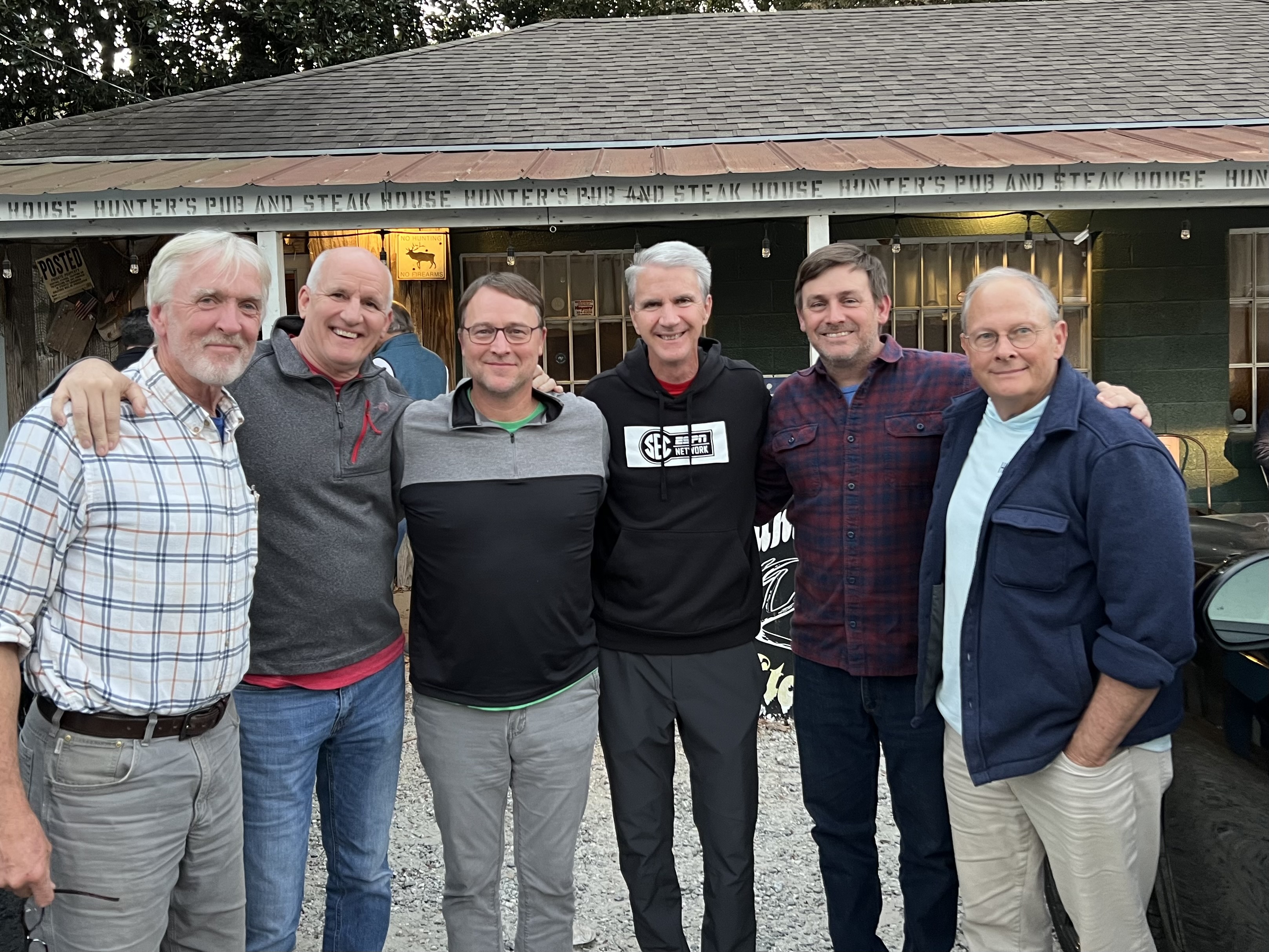
I asked if it was hard to walk into a group that was already so close.
“No, because they’re the type of people you don’t feel threatened by, in opening up and being in a relationship,” Bebo said. “They led by example. They didn’t tell me to walk in and tell my story first. They showed me the ropes and invited me into it. So it did not feel intimidating to me. It was a sweet thing pretty immediately.”
C. S. Lewis once wrote,
In each of my friends there is something that only some other friend can fully bring out. By myself I am not large enough to call the whole man into activity; I want other lights than my own to show all his facets. . . . Hence true Friendship is the least jealous of loves. Two friends delight to be joined by a third, and three by a fourth, if only the newcomer is qualified to become a real friend.
I don’t know if it was the addition of Bebo, or the length of time the men had been meeting, or the drama of COVID, which quickly followed. But something began to shift in the group around 2020.
“A little bit before COVID, it deepened somehow,” Dicky said. “I don’t really know why. I think we became more transparent with one another. When you taste the safety and the beauty of being loved by someone who doesn’t have to love you, you give a little more and you taste the richness of relationship.”
Around this time, Ben climbed out of a window, onto his roof, with a leaf blower strapped to his back. His goal was to blow the leaves off. But when he slipped, the fall was about 20 feet.
“When they called me and told me Ben was in the hospital, I rushed to the hospital,” Dicky said. “We go into the trauma [unit] and we’re going to see him for the first time. And there’s another guy with us and he said, ‘Hey, I didn’t know you and Ben were friends.’”
“We’re not,” Dicky said.
“Really? What?”
“Yeah, he’s not a friend,” Dicky said. “He’s a part of me.”

Allen’s Book
Ben had broken nine different bones. After three weeks in the hospital and months of physical therapy, he was mostly recovered. And the MOB was closer than ever.
By now, the men knew the patterns of their November meetings. Dicky was going to cry. Ben was going to lay out some theological clarity. Benson would offer to pass on his turn to share his story, and no one would let him. Bebo would always go long. And Allen would talk about the book he was writing.
“He talked for years before he started Theo about how he wanted to write long fiction,” Bebo said. “He just wanted to see if he could. And so when he started, each year we’d get a ‘Yeah, I’ve got a little bit.’”
And then, in 2022, it was done.
“We were like, ‘Hey, how’s it coming with the book?’” Bebo said. “Because he talked about it the year before, that was obviously one of our questions. He’s like, ‘It’s as done as it’s gonna be. I feel like it’s a complete story.’”
“OK, well, where is it?” they asked.
It was in a drawer.
To hear Allen tell it, Theo was a practice book, to get him warmed up to write the story he actually wanted to tell. But he didn’t mind sharing it with some of his closest friends.
When they read it, they all had the same reaction.
“It felt totally like him,” Ben said. “I cried a lot when I read that book—partly because I knew and loved the author, partly because I was like, ‘This is a masterpiece.’”
“I was in a particularly hard season of my life, and it wrecked me,” Bebo said. “It wrecked me. . . . When I first read it, I heard Allen reading it for the first third of the book. I didn’t hear Theo. When it switched for me and I heard Theo and I heard Ellen—I didn’t hear Allen reading Theo; I didn’t hear Allen reading Ellen—that was when I knew it was different. And I suspected that this was a good book.”
Could Theo Be Real?
A few months ago, Russell Moore interviewed Allen. Before he did, Russell asked on social media if anyone had a question they’d like him to ask.
“The question that’s been asked most—which I’ll ask you, but I’ll also give a theory as to what I think’s behind it,” Russell told Allen. “Number one question is ‘Is Theo based on a real person?’ And here’s why I think that question is being asked: I think people are either hoping that there is somebody like Theo out there or they’re afraid that there’s not.”
Allen’s friends have joked with him about this question, each wondering if hey, maybe he was thinking of them when he penned such a virtuous man.
But Allen told Russell, like he’s told everyone who has asked, that Theo is based on his brother, Gary.
Maybe. But here’s what his friends think:
“It makes sense to me how pieces of Theo are Gary,” Bebo said. “Gary was winsome and kind and all those things, but he was very direct and abrupt and pointed. He got to the gospel the second he met you. He didn’t waste time. Theo is much slower.”
“Gary was so generous, and he was very attentive to detail, and he loved to surprise people,” Benson said. “But the tenderness and attentiveness and patience and kindness and not giving away the 92 portraits at one time—that’s Allen.”
“While he might not say he’s Theo, in this group we all look at him and go, ‘Yeah, I know you think it’s Gary, but we kinda think it’s you,’” Dicky said.
“He will say the book’s not about him, that he’s not Theo except aspirationally, and that is true,” Ben said. “But he’s doggone close.”
“Allen is the most Theo person that we all know,” Bart said.
If you’re counting, that’s five for five. Allen’s friends were all recognizing in Theo the same gentle generosity and close attention to people they saw in their friend. But the similarity is even stronger than that.
They knew that when he was at the University of Georgia, he saw and developed friendships with people no one else did—like those serving the meals in the dining halls. They knew that when he was in Scotland, he helped an elderly widower home through the icy streets. They knew he’d just spent a year writing a song every day, which made him pay attention to everything.
And then there’s this: In 2018, Allen released an album called People in My Town.
“So he took a group of people that lived within a few miles of him, and he went and introduced himself and asked if he could talk with them,” Benson said. “And then he wrote a song for that person, and he had Gary Pound, the artist, make a portrait of them. I think there were seven.”
Allen invited them all over to his house.
“He has this great round table, where you can see everybody’s face,” Benson said. “He served them dinner, and one by one, he handed them their portrait, and then sat beside them with his guitar and played the song that he wrote for them. And of course, they just sobbed.”
When Allen’s friends read Theo of Golden, they cried because it was good. But they also cried because they recognized the protagonist.
Later, Dicky said of Allen, “He’s been writing [this book] his whole life.”
The Bestowal
Publishing a book is easier said than done. Allen floated his manuscript past one publisher, who turned him down. Rather than continuing to knock on those doors, he decided to self-publish.
He didn’t know how, so he hired his niece Aron Ritchie to help. They worked hard at it. Aron researched how to publish a book. The two of them updated his website, brainstormed a list of connections he could ask to spread the word, and made plans to connect with book clubs.
It was a lot of effort for something that could go nowhere.
So just before the book came out, Allen’s friends decided to encourage him during one of their MOB weekends.
“It was really Benson’s idea,” Bart said. “There’s this great restaurant in Columbus and I happened to know the owner and asked her if she would be willing to come out and do a meal for us. And then I reached out to Gary Pound, who did all those portraits in Fountain City Coffee, and said, ‘Hey, would you do one of Allen?’”
Fountain City Coffee is the real-life coffee shop in Columbus that inspired Allen’s fictional coffee shop in Golden. Portraits really do hang on the walls, drawn by Allen’s friend Gary.
While Bart and the other guys were making these calls, they didn’t tell Allen what they were planning.
“The van pulled in,” Benson said. “And Allen is very protective of the farm in general, but I think that’s when he had sold some of it, and he did not want anybody going on that side of the property. And so when that van went by, Allen got alarmed and walked out there, a little defiantly and protective. The van turned around, and he’s of course being kind, but he’s [got this] look on his face, and he’s thinking, ‘What is going on?’”
The doors opened, and two women emerged with aprons on.
“And Allen melts, and then we show them in the kitchen,” Benson said. “They served us an amazing meal. When Allen came in, the table was decorated, and he’s curious, but nothing’s been revealed yet. So the meal’s wonderful. Then the portrait was brought out, and Allen stands up and opens it and looks at it. And then we went around the room and told him what we see in him.”
Poor Allen didn’t stand a chance.
“He put his head on the table, his arms folded on top of his head, and he didn’t cry—he wailed,” Benson said. “And it wasn’t for 30 seconds. It was four or five minutes. And the two chefs came out and were watching and were just astonished, and they had tears in their eyes. I don’t cry, but I was crying, because to see Allen knew that he was really loved by us, and that we would do something like that . . .”
At one point, through his tears, Allen managed to get out, “This is what Gary would have done,” which made him cry even harder.
“It was connected with the grief, which really makes me sad,” Benson said. “I wish Gary was around to be with Allen through all of this. That was one of the most beautiful nights of my life.”
Here’s how Allen explained it later, in a public talk he did with Dicky.
“It was an expression of their affirmation and their love for me,” he said. “Theo of Golden would never have seen the light of day but for these guys getting behind me and pushing me. And I pray for all of you that you’ve got people like that in your life who would have your portrait done and tell you things about yourself that you could never believe to be true.”
Then he grinned at the audience.
“I will tell you a dilemma that they created for me,” he said. “So somebody gives you a portrait of yourself—what are you going to do with it?”
Breakout Bestseller
In the first few months, Theo of Golden sold 3,000 copies. A lot of those were to Allen’s friends and family.
“I bought a case of them,” Bebo said. “I gave them away for Christmas gifts that year to a lot of people. And I remember writing in the front of them, ‘I have no idea if this is actually a good book because I am so biased. It’s written by a man that I love, a dear friend, and it was read at a season in my life where I needed kindness more than anything in this world. And it wrecked me. But I need to give this book to you, because you have shown kindness in my life. I hope that you’ll receive kindness in this book.’”
“We all bought our 40 or 50 copies and gave it to friends,” Dicky said. “Allen has hundreds and thousands of friends. . . . At some point he wrote us and said, ‘Hey, we’re no longer in the red! We made a dollar!’ And we celebrated. And it kept on going. People would start talking about it, and they’d sell more.”
In 2024, Allen sold about 25,000 copies of Theo, which was 24,000 more than he was hoping for. He and Aron thought sales would begin to drop in 2025; instead, they climbed even higher. Pretty soon, they were selling a thousand copies a day.
That caught the attention of large publishers, who were so interested they got into a bidding war. Two years after Allen published Theo, Simon & Schuster rereleased the book. Four months later, it had sold more than a million copies in the United States alone. Three months later, it had sold another 1.5 million copies.
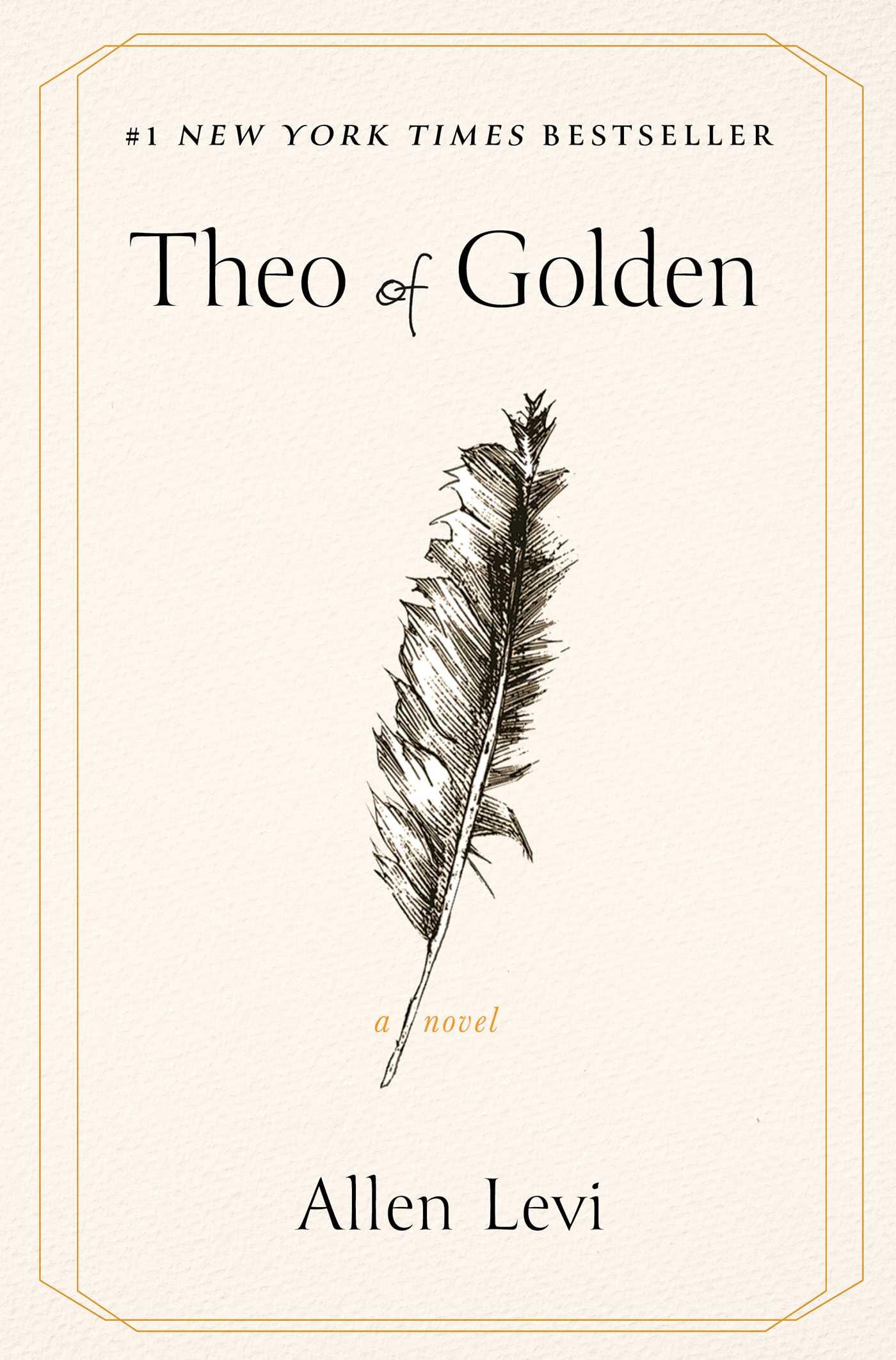
Theo of Golden has been read by thousands of book clubs, including Katie Couric’s. Oprah and Jenna Bush Hager both raved about it. Tourists are flocking to Fountain City Coffee and other landmarks in Columbus fictionalized in the novel.
His friends can hardly believe it.
“We all felt like he had the skills to do it,” Bebo said. “But who thinks they can actually write a novel that’s gonna be anything?”
“Gobsmacked,” Ben said. “You just can’t believe it.”
“We look at this and we’re like, ‘Are you kidding me?’” Dicky said. “Unbelievable. Just crazy.”
A Christian Life
Readers of Theo report almost conversion-like experiences: “It changed me instantly,” said one. “My heart shattered into thousands of pieces,” said another. A third wrote, “I, too, have tasted heaven reading this.”
That’s interesting, because the point of Theo is fairly simple—in fact, it’s the same message that’s in Allen’s songs. He’s describing a life that is gentle, attentive, intentional, and communal—a life of love rooted in and empowered by the love of God. In other words, a Christian life.
“Maybe what Theo has done, in our societal moment, [is to show us that] we long for people like that to be real, and to be in our lives, and to be those people,” Ben said. “It’s aspirational for sure. It’s hopeful. It hearkens to what really matters. Maybe we can all be generous, thoughtful, kind-hearted. We can all take action to do those things.”
In our cultural isolation, there’s a hunger to be known by a community of people, he said.
“My old pastor Bob Flayhart would say, ‘The gospel is for me, but it’s not about me,’” Ben said. “And that is really the community that Theo had—it was for him, but not about him. It’s not about you; it’s about taking what you have been given and giving it to others.”
You might think that a man who is now a best-selling author, asked to do more interviews and events than anyone has time to do, executive producing a major motion picture, and working on another book, might not be able to hang out quite as much as he used to.
For Allen Levi, it’s the opposite. The MOB has added a day to their annual November gathering—now they hang out for four days instead of three. Then they added Zoom calls every other month or so. For 90 minutes, they talk about Dicky’s son getting married, what retirement is going to be like, and what’s going on with Theo.
“I think we all probably needed each other a little bit more,” Bart said. “Certainly, being together more has made us want to be together more. It’s made us want to talk more. So that feels really good.”
In many ways, this friend group carries the pattern of sanctification. As these men slowly, consistently, over a long period of time, push each other toward Jesus, they can see richer and deeper virtues developing in themselves and in each other.
Allen’s book has pushed them further in the direction they were already going. Benson, who is a hospice chaplain, has taken up letter writing. Dicky, who is a school superintendent, led his leadership team through a Theo of Golden study this year. (“We had the deepest, most thoughtful conversations,” he said.)
All the MOB members want to pay better attention to their own lives, to notice people, to ask about their stories, and to love them well.
They’re following Allen’s example, and I was starting to get suspicious about something.
Is Allen Levi perfect?
Be a Friend like That
“By no stretch is Allen Levi perfect,” Bebo said, laughing. “And he will be the first to tell you.”
“No, he is not perfect,” Ben said. “He is very self-aware in that regard, and I think the gospel means so much to him because he knows of his own depravity. It’s the same tension as ‘You’re far worse than you think you are, and you’re more loved and accepted than you can hope.’ Allen lives that out.”
“No, and he would be the first to tell you he’s not perfect,” Bart said. “But he really personifies Christ in lots of ways. He’s broken, he’s fallen, but he’s trying to center his life around Jesus and allow Jesus to shape him and help him. And so when he does screw up and mess up and stumble and fall, he’s got this deep well of Christ’s [grace], this deep centering on Jesus that helps bring him back to health.”
Allen Levi is just a guy, living in a small town in the South, reading his Bible and loving his neighbors and using his gifts to the glory of God. In Theo, he’s given the world an example of a man who has suffered loss and heartache, who sees people around him, and who gives them his careful attention and genuine affection. Allen and Theo are showing the world a compelling Christianity.
I don’t know if you have a friend like that. But I do know you can be a friend like that.
“My advice might be to put down the smartphone, look people in the face, and just go for it,” Bart said. “If you have a group, throw it out there. Be bold and courageous, and say, ‘Hey, what if we got together and did this more regularly? Or what if we were a little more intentional about our friendship?’”
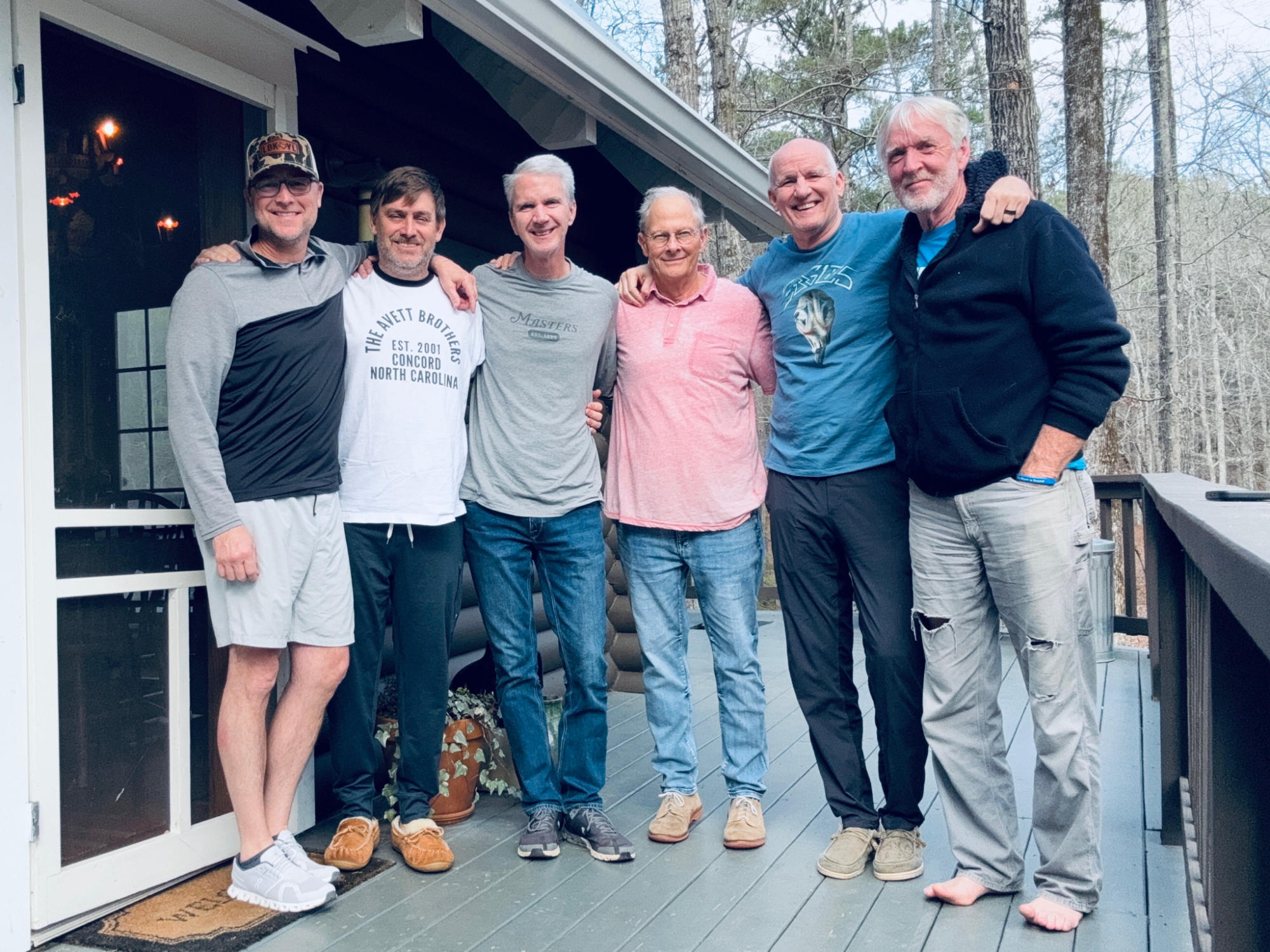
When you do this, be sure the friendship can be built on something bigger than yourselves. Ben is old enough to have seen baseball friends and soccer friends and football friends come and go.
“You may have some commonalities,” he said. “You certainly have children in common who are playing on this team or doing this recital or dance team or whatever it might be. The illusion is that you think, Well, these are my friends. But you’re only friends for a season because you’re only friends because of the mutual interest that your children have, and so the children are what are bringing you together.”
The key to a deeper, longer-lasting friendship is that it has to be built on something deeper and longer-lasting, he said.
“And the deeper the object of what the friendship is about, the deeper the friendship,” he said. “If it’s about work, well, that’ll go so far. If it’s about your kids’ youth sports or their activities or Scouts, it’ll only go so far. But if it’s about ultimate things and things that matter deeply, then I think there’s a real chance for it to last.”
When you find those people, work at that friendship.
“Intentionality, patience, and—what is the Tim Keller book?—self-forgetfulness,” Dicky said. “If you want to make good friends, see the good in other people and tell them what you see. As you do that, they will begin to tell you more about themselves. You don’t make friends by telling people who you are. You make friends by extracting who they are.”
You can do this at church, in week after week of drinking coffee with someone after a service. You can do this in your Bible study or discipleship group or small group. You can do it in quarterly Zoom calls or annual weekend retreats.
Remember when I told you about the inscription at the bottom of the copyright page of the self-published copies of Theo? “In collaboration with the MOB Consortium?”
Well, after that, there’s another set of secret initials—TTK.
When the MOB is together for a meal, they always bow their heads to pray. After the “Amen,” they lift their glasses to each other. But they aren’t toasting success, or happiness, or their wives and children, or even each other.
Instead, they toast the foundation of their lives, the reason they’re together, and the destination they’re helping each other aim for.
They say, “To the King!”
Popular Products
-
 Mommy Diaper Backpack with Stroller O...
$111.56$55.78 -
 Ai Dash Cam with Front & Rear HD, GPS...
$295.56$147.78 -
 Smart Auto-Recharge Robot Vacuum Cleaner
$613.56$306.78 -
 Wireless Health Tracker Smart Ring - R11
$131.56$65.78 -
 Electric Hair Straightener and Curlin...
$161.56$80.78